5. Patrols & Lifesaving
Printed 11 October 2026
5.1
Patrols Explained & Who Can Patrol
Updated 3 Oct 2026 · Grant
Patrolling is the core function of a surf life saving club. Every patrol hour served at Trigg Island Beach directly helps keep the community safe. The club holds a Patrol Contract with the City of Stirling that sets its patrol obligations and minimum service levels — the patrol season generally runs from October to the end of March, with exact dates confirmed each year by the Director of Lifesaving.
Requirements to patrol
Before you can patrol, you need to meet every one of these requirements:
Be a current financial member, registered in the SLS Members Hub
Hold a current SLSA award for your role (Surf Rescue Certificate for Cadets, Bronze Medallion for Active members)
Be proficient — annual Skills Maintenance completed by 31 December
Hold a current Working With Children Check where required
Be allocated to a patrol team by the Patrol Officer
No exceptions
A member who isn't financial, isn't proficient, or doesn't hold the right award for their role must not patrol. Patrolling without these in place breaches SLSA policy and may void your personal accident insurance.
Patrol requirements for Active Members and Cadets
Once you hold an eligible award — a Surf Rescue Certificate for Cadets, or a Bronze Medallion for Active members — you'll be allocated to a Club patrol team by the Patrol Officer.
You must complete the Club's full patrol roster for the season, unless you've been approved for an Individual Patrol Agreement (IPA) or hold an approved patrol exemption — see Individual Patrol Agreements & Exemptions
If you can't attend a rostered patrol, you must arrange a substitute holding an equivalent qualification, accepted through the SLS Members Hub — see Can't Make a Patrol?
If a patrol is missed, you must make up the hours by accepting another member's patrol swap request in the SLS Members Hub
Deficit
A member who does not attend a rostered patrol without an accepted substitute is considered in deficit and has not met their membership obligation — see Patrol Deficit & Consequences.
This still applies if you're on an IPA: your IPA sets an alternative schedule, but you remain responsible for arranging an accepted substitute for any individual absence within that schedule, and failing to meet your IPA commitments is treated as patrol default in the same way.
5.2
Patrol Roles & Award Requirements
Updated 15 Aug 2026 · Content
The award you hold determines the role you can perform on patrol. Each patrol is led by a Patrol Captain, supported by the team below.
| Role | Minimum award |
|---|---|
| Patrol Captain | Bronze + Silver Medallion Patrol Captain (18 years+) |
| Patrol Vice Captain | Bronze Medallion (Silver Medallion recommended) |
| Patrolling Lifesaver | Bronze Medallion |
| Patrolling Cadet | Surf Rescue Certificate (U13–U15), under supervision |
| Award Member | Relevant award, e.g. Radio, First Aid |
| IRB Driver | Silver Medallion IRB Driver + current driver's licence |
| IRB Crew | IRB Crew award + current proficient patrolling award |
| Observer | Observer Award — supervised, no independent duties |
Patrol Captain's authority
During patrol, the Patrol Captain has full operational authority over all members and activities in the patrolling area. Every member must follow the Patrol Captain's (or Vice Captain's) lawful and reasonable directions — this authority is non-negotiable during a patrol, and any disagreement or concern is raised afterwards through the appropriate channel, not on the spot.
5.3
The Roster, Sign On/Off & Your Hours
Updated 25 Sep 2026 · Grant
The patrol roster for the season is confirmed by 1 October and published in the SLS Members Hub, where you can also check your current patrol hours at any time:
Log in to the SLS Members Hub
Go to More > Patrols > Patrol Hours. You're responsible for knowing your patrol dates and committing to your schedule.
Your obligation
As an Active Member, your Club patrol obligation is to complete the Club's full patrol roster each season — either by personally attending every rostered patrol, or by arranging an accepted substitute through the SLS Members Hub for any you can't make (see Can't Make a Patrol?). An informal arrangement that isn't recorded in the Hub doesn't satisfy the obligation.
Membership category | Minimum patrol hours |
|---|---|
Active (15–18) and Active (18+) | Full patrol roster each season |
Active Reserve | As set by the Board each season |
Cadet (U14) | Minimum 16 hours, supervised |
Cadet (U15) | Full patrol roster |
Award Member | Full roster if assigned to a team |
Sign on and sign off
Signing on confirms who's on the beach, and it's the only way your hours are counted. Arrive ready for duty before the patrol starts (your Patrol Captain will confirm arrival times), sign on using the club's approved patrol recording system, check your equipment and radio with the Patrol Captain, and sign off before you leave at the end of your shift.
Always sign off
Patrol hours aren't counted unless you're correctly signed on and off — even if your replacement has already arrived. Running late? Let your Patrol Captain know as early as possible so coverage can be managed.
Patrol hours ≠ competition eligibility
Completing your Club roster — including via accepted substitutes — satisfies your Club membership obligation. It does not automatically satisfy SLSA's competition eligibility requirements, which are set independently and can't be waived by the Club. Patrols covered by a substitute count toward your Club obligation, but not toward your own personal patrol hours for competition — see Competition Eligibility & Patrol Requirements in Surf Sports & Competition.
5.4
Can't Make a Patrol?
Updated 25 Sep 2026 · Grant
Life happens — the key is to give as much notice as possible and arrange a substitute through the SLS Members Hub. When another qualified, proficient member accepts your swap, your obligation for that patrol is met and no make-up hours are needed. If no substitute is found, the missed patrol is recorded as a deficit (informally, you'd say you're "hours down").
Requesting a substitute
Log in to the SLS Members Hub at hub.sls.com.au
Go to More > Patrols > Upcoming Patrols to see your allocated patrols
Find the date you can't attend
Select "Request substitute" — the listing updates to show it as requesting a substitute
Raising the request in the Hub is the first step — for anything less than 48 hours' notice, also contact your Patrol Captain directly and, if it's urgent, other patrol members too (see the notification table below).
Accepting someone else's patrol
Log in to the SLS Members Hub
Go to More > Patrols > Patrol Substitutes Needed
Scroll to the list of patrols other members have flagged as needing a substitute
Find one you're eligible and available for, and select "I can do this"
Confirm when prompted — this accepts the substitution and updates both rosters
Exact wording may vary
These are the standard steps for the SLS Members Hub, the national platform every Surf Life Saving club uses — exact button wording can shift slightly with platform updates. If anything looks different, use the Hub's own help, or ask the Club Administrator.
Watch your competition hours
A substitute swap satisfies your Club obligation for that patrol, but it doesn't add to your own personal patrol hours. If you're aiming to compete at State or National Championship level, you need 16 personally-attended patrol hours from the calendar year prior — relying heavily on substitutes can leave your Club obligation met while you're still short for competition. See Competition Eligibility & Patrol Requirements in Surf Sports & Competition.
Notice given | What to do |
|---|---|
More than 48 hours before | Notify your Patrol Captain and raise a substitute request in the Hub immediately; monitor and follow up |
Less than 48 hours before | Notify your Patrol Captain immediately, raise the request in the Hub, and also contact other patrol members directly for urgent cover |
Emergency or same day | Call your Patrol Captain directly first, then raise the substitute request in the Hub as soon as practicable |
Making up hours
If you're hours down, you can make up the deficit by accepting a future-dated swap in the Hub (this restores your entitlements straight away), covering someone else's patrol as a substitute, or completing a patrol the Director of Lifesaving has marked as eligible for make-up.
5.5
Patrol Deficit & Consequences
Updated 15 Aug 2026 · Content
A patrol deficit builds up in two ways: hours deficit from partial absences (late arrival or early departure), or a missed patrol — a fully missed rostered patrol without an accepted substitute. Both are tracked, and consequences apply automatically unless you've accepted a patrol swap (including a future-dated one) or hold an approved exemption.
"Deficit" is the formal term used in Club policy — you'll commonly hear members call it being "hours down." They mean the same thing.
| Deficit level | Consequences |
|---|---|
| In deficit (any hours owed, or a missed patrol) | Not entitled to train using club facilities, compete, or use club-owned surf sports equipment or the gym |
| 8 deficit hours or 2 missed patrols | All the above, plus ineligible for club trophies, awards or incentives. Written notice from the Director of Lifesaving. |
| 12 deficit hours or 3 missed patrols | Membership may be suspended or terminated by the Board, with written notice and a right to respond first |
Entitlements are restored once you accept a patrol swap in the Hub, pending completion of that patrol. These are club consequences and sit alongside — not instead of — SLSA's separate competition eligibility rules; see Surf Sports & Competition.
5.6
Individual Patrol Agreements & Exemptions
Updated 15 Aug 2026 · Content
Individual Patrol Agreements (IPA)
An IPA is a formal, documented arrangement that changes how you meet your patrol obligation — not a reduction of it. You still serve the same total hours as other members of your category, just on a different schedule. IPAs may be available where you genuinely can't attend at least 50% of the standard roster due to FIFO or irregular work rosters, employment commitments outside your control, or other exceptional, ongoing circumstances approved by the Board. They're not available for lifestyle preferences, routine scheduling conflicts, members already in deficit, or short-term situations (use a patrol swap instead).
To apply, submit a written application to the Director of Lifesaving explaining your circumstances and proposed arrangement. If approved, the IPA is documented, signed by both parties, and reviewed at least annually — it doesn't automatically renew. If declined, you can request a review by the Board, whose determination is final.
Patrol exemptions
A patrol exemption is temporary or seasonal relief from patrol obligations, for situations that genuinely can't be managed through a patrol swap or an IPA — injury or illness, pregnancy, military or emergency service deployment, extended travel or work away from Perth, or other exceptional circumstances the Board approves.
A Club exemption applies only to Club membership obligations — it doesn't affect your separate obligations under SLSA Policy 5.04 for competition eligibility. Apply in writing to the Director of Lifesaving before the season starts, or as soon as practicable after an unexpected event.
5.7
Fitness for Duty & Conduct on Patrol
Updated 15 Aug 2026 · Content
Fitness for duty
You must present for patrol ready and capable of performing your assigned duties. You must not patrol if you're under the influence of alcohol or any impairing substance, suffering an injury or illness that prevents you safely performing your duties, or in a state that impairs your judgement or ability to respond to an emergency. If you're unwell, injured or otherwise unfit, notify your Patrol Captain as early as possible so cover can be arranged.
Where illness or injury strikes with no reasonable opportunity to arrange a substitute, your Patrol Captain can excuse you from that patrol — it won't count as a deficit. If you're likely to be unable to patrol for an extended period, consider applying for a patrol exemption.
Conduct on patrol
- Follow the SLSA Code of Conduct and the club's Membership Policy at all times
- Be professional and courteous with the public, fellow patrol members, and other services (City of Stirling Lifeguards, WA Police, the Surf Rescue Helicopter crew)
- Don't use your personal phone for non-emergency purposes during active patrol hours, unless the Patrol Captain authorises it
- Stay vigilant and alert — patrolling requires sustained attention and readiness to respond
- Don't consume alcohol or any impairing substance during patrol hours or in the patrol area
Conduct that puts the public, fellow members, or the club's reputation at risk is taken seriously — see Patrol Deficit & Consequences and Complaints, Grievances & Discipline.
5.8
Incident Reporting & Equipment
Updated 24 Sep 2026 · Grant
All incidents — rescues, first aid treatments, preventive actions, near-misses and injuries to members or the public — must be reported through the SLSA incident reporting system, ideally before or immediately after sign-off. Accurate, timely reporting creates an official record of the club's service, supports insurance requirements, and is a requirement of the Patrol Contract with the City of Stirling.
Critical incidents
If an incident meets the definition of a Critical Incident — a fatality, serious injury, significant near-miss, or anything likely to cause significant distress — it triggers the Club's Critical Incident process straight away. See Critical Incidents & Support.
Equipment
Use equipment only for its intended purpose and in line with SLSA training and club procedures. Report any damage, loss or malfunction to the Patrol Captain immediately, return everything to its correct storage location in serviceable condition at the end of each patrol, and don't use or modify club equipment without the Patrol Captain's authority. Vehicle operators (ATV/SSV, IRB) must hold the relevant SLSA award and a current driver's licence for land vehicles.
5.8.1
Radios
Updated 23 Sep 2026 · Grant
Trigg's patrol radios are Icom handhelds that work on two networks at once: the Telstra mobile network for the Metro channels, and VHF for line-of-sight channels. The radio carries two channels at the same time, one on each transmit button. A radio induction is required before you patrol.
Which channel to use
Broadcast all patrol operations on Metro Wide so Surfcom monitors and records them. Use VHF or your club channel for admin, training and other non-patrol traffic. Formal radio protocols apply on every channel, every time.
Start up
Take the radio off the charger.
Turn on with the On/Off/Volume knob and set the volume.
Wait while it connects to the Telstra network — up to 40 seconds.
Check the two channels shown, then hold CLR to lock the keypad.
How to transmit
The display shows two channels. The top line is the channel on the top (large) PTT, and the lower line is the channel on the bottom (small) PTT. To swap them, press and hold FUNC.
Button | Channel | What it is |
|---|---|---|
Top PTT — large | Metro Wide | Telstra network. Surfcom monitors this channel. Listen before you speak; a beep confirms the channel. |
Bottom PTT — small | VHF1 – Ops | VHF, line of sight only. Use for club communication. Neighbouring clubs may be heard. |
On patrol
Keep Metro Wide as the top channel, on the large PTT.
Listen before speaking — several members can talk on the Telstra channels at once.
Use “Over” or “Out” so others know when the channel is clear, and keep to standard pro-words.
Surfcom monitors only the Area Wide channels day to day, and may move the club to another channel during a major incident.
VHF Marine channels
Only use the VHF Marine channels when directed to by Police, Marine Rescue or Surfcom. Improper use may result in fines.
Metro channels
Channel | What it is |
|---|---|
1 | Metro Wide — Surfcom monitored |
2 | Metro Ops |
3 | Metro ERT |
19 | Trigg Island — club channel |
01–05 | VHF Ops — line of sight |
06–18 | VHF Marine — when directed |
The controls
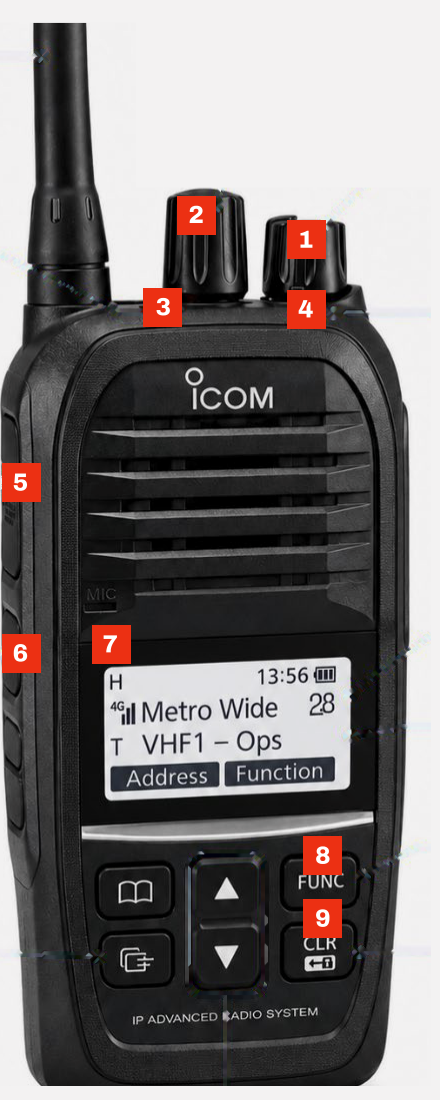
# | Control | What it does |
|---|---|---|
1 | On/Off/Volume | Turn on, set volume |
2 | Channel Selector | Changes the top channel |
3 | Emergency Distress | Distress button |
4 | Indicator | Red transmitting, green receiving |
5 | Top PTT (large) | Transmits on the top channel |
6 | Bottom PTT (small) | Transmits on the lower channel |
7 | Display | The two channels you are on |
8 | FUNC | Press and hold to swap the two channels |
9 | CLR | Press and hold to lock / unlock the keypad |
When you finish
Turn the radio off, make sure it is dry, and put it back on the charger.
Where this comes from
SLSWA Icom Radio Guide v1.1. A radio induction is required before patrolling — ask your Patrol Captain if you have not done one.
5.8.2
Public Warning System
Updated 23 Sep 2026 · Grant
Trigg Beach has a siren system for warning the public — to clear the water, to call every available lifesaver, and to signal that the water is open again. It belongs to the City of Stirling and covers three zones: North, Middle and South. Most of the decisions below belong to the Duty Patrol Captain, but everyone on patrol should know what the signals mean and what happens afterwards.
What the signals mean
Signal | What it means |
|---|---|
Continuous tone | Evacuation — get the public out of the water |
Three short blasts | Lifesaver alert — all available lifesavers respond |
One short blast | The water is open again |
Who can sound it
City of Stirling Beach Inspectors activate the siren remotely, and are the only ones who can sound a single zone.
The override switch in the patrol tower sounds all three zones at once. Tower observers use it, and only on the authority of the Duty Patrol Captain.
How to sound it
The normal way is to ask the Duty Beach Inspector over the radio and let them activate it.
Use the override when the Beach Inspector cannot be reached, or when waiting for them would put someone at risk. The Patrol Captain authorises it, and says why over the SLSWA radio network as it happens.
Before you reach for the switch
The siren is heard by the whole beach and everyone near it. Sounding it when it is not needed causes alarm and costs the club public trust. Every activation is a decision the Patrol Captain owns and has to be able to explain afterwards.
When to sound it
Situation | What to do | Signal |
|---|---|---|
Confirmed shark sighting | Ask the Duty Beach Inspector. Override if they are uncontactable, or the delay is unreasonable. | Continuous tone |
Shark attack, major emergency, or anything needing the water cleared | Ask the Duty Beach Inspector. Override straight away if there is immediate danger to life. | Continuous tone |
Mass rescue — calling in every available lifesaver | Ask the Duty Beach Inspector. Override if contacting them is delayed or impractical. | Three short blasts |
Reopening the water once the area is safe | Ask the Duty Beach Inspector. Override if they are unavailable. | One short blast |
Say it on the radio
Every activation — whether you asked for it or used the override — goes over the SLSWA radio network, with the reason. That is what creates the recorded account of the decision. Keep it short and specific:
For example
“Trigg Patrol Captain authorising full siren activation due to confirmed shark sighting — Duty Beach Inspector uncontactable.”
After the siren
If you used the override, tell the Duty Beach Inspector as soon as you practically can.
Write it in the patrol log: the time, the reason, whether it was requested or overridden, who authorised it, and that the Beach Inspector was notified.
Report the activation to the Patrol Officer, or the relevant City of Stirling contact, if that is required.
If it is not clear cut
Two situations come up often: the Beach Inspector is contactable but their response time might create risk, and a shark sighting that is not fully confirmed. There is no rule that settles these — the Patrol Captain decides, and the call is theirs.
Put public safety first, say what you are doing and why over the radio, and write it down. A decision that is explained and recorded holds up; a silent one does not.
5.9
Water Safety
Updated 15 Aug 2026 · Content
No Club activity in or near the water — Nippers, training, Surf Sports, even patrol support activities — can go ahead without water safety in place. It's a core part of how Trigg Island SLSC keeps everyone safe, and it relies entirely on volunteers.
No water safety, no activity
If an activity doesn't have adequate water safety cover, it cannot proceed. This applies right across the Club — Nippers sessions, Youth and Surf Sports training, and other aquatic activities all depend on it.
We're always looking for volunteers
Water safety depends on members stepping up — the Club is always looking for more volunteers to help. If you hold a Surf Rescue Certificate or Bronze Medallion, you're qualified to help provide water safety for training and other activities, beyond your own patrol commitments.
Volunteering via PatrolMate
Trigg Island SLSC uses PatrolMate, an online app, for members to volunteer for water safety and other Club helper roles. It's the easiest way to see what help is needed and put your hand up.
The basics of how water safety works
Water safety at Trigg Island follows the SLSA Water Safety Procedure (Policy 1.01A). The full detail is technical, but the general principles are:
- Every activity has a Water Safety Supervisor — a Bronze Medallion holder who leads the water safety team, assesses the risk before and during the activity, and stays on the beach coordinating the response
- They're supported by Water Safety Personnel — members holding a Surf Rescue Certificate or Bronze Medallion, positioned on the beach or in the water as directed
- Before an activity starts, the Water Safety Supervisor completes a risk assessment and puts together a water safety plan — covering conditions, numbers, the team, and what to do in an emergency
- Minimum supervision ratios apply, based on conditions and how experienced the participants are — riskier conditions or larger groups need more water safety cover, and some conditions mean an activity simply can't go ahead
- Everyone providing water safety wears identifiable high-vis gear, and rescue equipment must be on hand and ready to use
Full detail
This page covers the general principles only. The complete SLSA Water Safety Procedure — including exact supervision ratios and equipment requirements — is available from the Director of Lifesaving or the SLS Hub Document Library.
Getting involved
If you'd like to help with water safety — for Nippers, Youth, Surf Sports training or otherwise — register your interest via PatrolMate, or speak to the Director of Lifesaving.