2. Membership
Printed 11 October 2026
2.1
Membership Categories & Fees
Updated 22 Aug 2026 · Rochelle
Age reference date
Your (or your child's) age for membership category purposes is your age on 30 September in the year the season starts. For the 2026–27 season, the reference date is 30 September 2026. Example: a member who is six years old on 30 September 2026 will enrol in Junior Activity U7.
Trigg Island SLSC offers a category for almost every way of being involved, from five-year-old Nippers through to Life Members. This page is a plain-language summary — the full detail sits in the Club's Membership Policy (MEM-001).
Junior members (Nippers)
Category | Age | Notes |
|---|---|---|
Junior Activity (U6–U7) | Under 8 | Play, participation and fun. Must be accompanied by a financial Nipper Parent. |
Junior Activity (U8–U13) | 8–13 years | Core Nipper program; progresses through Surf Education Certificates each year. |
Adaptive / Inclusive Program | 5–99 years | Adapted curriculum for participants of All Abilities, determined case by case. |
Every Nipper needs at least one parent or guardian registered as a Nipper Parent member — without one, the Nipper registration can't be finalised.
Cadet members (13–15 years)
Cadets hold the Surf Rescue Certificate and begin patrol duties: a minimum of 16 hours a season at U14, and a full patrol roster at U15. Annual Skills Maintenance is due by 31 December.
Active members
Active membership is the operational core of the club — Bronze Medallion holders who patrol, vote, compete and can hold office. This covers Active (15–18), Active (18+), Active Reserve (available after 8+ years of satisfactory service, by application) and Award Members (hold a patrolling award short of the full Bronze Medallion, such as Radio or First Aid). A one-off Bronze Levy applies the first time you join as Active or Probationary without already holding a Bronze Medallion.
Probationary and Associate members
Probationary membership (18+) is for members actively working toward their Bronze Medallion. Associate categories — Associate General and Nipper Parent, and Leave/Restricted Member — support parents and members on approved leave, without patrol obligations.
Honorary, Service and Community members
Life Member and Long Service categories recognise long-term contribution and are granted by Board resolution. Community categories — Gym, Silver Salties and Social — are for people who want to use specific facilities or join in club life without becoming an operational lifesaver, and are covered by the Club's public liability insurance rather than SLSA personal accident insurance.
Membership fees
Category | Season cost |
|---|---|
Junior Activity (U6–U13) | $190 |
Cadet (13–15 years) | $215 |
Adaptive (All Abilities) | $80 |
Active (15–18 years) | $230 |
Active (18+), Active Reserve, Award, Long Service | $230 |
Nipper Parent | $130 |
Gym | $450 |
Silver Salties | $150 |
Community | $130 |
One-off fees also apply for board/ski rack storage ($75 / $95) and completing a Bronze Medallion ($100).
Payment deadline
Fees cover 1 October to 30 September and are due by 30 September each season. Unpaid fees can mean suspension from patrol, club activities and facility access until payment is confirmed.
Family fee cap
Once a family reaches the Family Membership Fee Cap, no further base membership fees apply for eligible family members that season. A family is up to two adults plus any number of dependent children in Junior Activities, Adaptive or Active (15–18) categories. The cap covers base fees only — course fees (including the Bronze Levy), equipment storage and competition entry fees are always payable separately. Contact the Club Administrator to apply the cap when registering.
2.2
Joining & Renewing Your Membership
Updated 22 Aug 2026 · Rochelle
All registrations and renewals happen through the SLSA Members Hub — the national online membership platform — at hub.sls.com.au.
New members
- Create a personal account at hub.sls.com.au (a parent or guardian must create the account for a child).
- Search for and select Trigg Island Surf Life Saving Club.
- Choose the membership category that applies to you or your child.
- Complete your details and submit any required documents — proof of age (birth certificate or passport) for Junior members, and a Working With Children Check for Nipper Parents and anyone working with children.
- Pay your fees.
- Wait for the Club Administrator to approve your application — you're not a financial member, and can't train, patrol or compete, until it's approved and confirmed.
Joining to do your Bronze Medallion?
Select Probationary as your category — the Bronze Levy is included in the Probationary fee.
Returning members
Renew each season from 1 July, once the new season's fees are published. If you've set up a Family Group in the Hub, the primary account holder can renew everyone together — each person still keeps their own individual record.
Season timeline
| Date | Milestone |
|---|---|
| 1 July | Fee schedule approved; renewal portal opens |
| 1 September | Seasonal call for renewals and new registrations begins |
| 30 September | Prior season membership expires; age reference date |
| 1 October | Fees due; patrol season commences |
| 31 December | Deadline for annual Skills Maintenance (patrolling members) |
2.3
The SLS Members Hub
Updated 17 Aug 2026 · Grant
The SLS Members Hub (hub.sls.com.au) is the national online platform Surf Life Saving Australia uses for membership, awards, patrols and communication — every SLS club in the country runs on it, including Trigg Island. Each financial member has their own individual login; a parent or guardian creates and manages the account for a child.
What you can do in the Hub
Join or renew — register a new membership, or renew each season from 1 July, including as part of a Family Group
Manage your patrols — view your roster and patrol hours (Patrols > Patrol Roster), and request or accept a patrol swap (Patrols > Patrol Swap) — see Can't Make a Patrol? in Patrols & Lifesaving
Complete training — work through Skills Maintenance eLearning modules, and register for courses and practical assessment sessions
Check your awards — view your current awards and proficiency status, recorded in Surfguard
Access the Document Library — SLSA and SLSWA policies, circulars and step-by-step user guides
Update your details — keep your contact details, emergency contacts, medical information and Working With Children Check record current
Raise a formal complaint — lodge a matter through the SLS Reporting System where that's the right pathway — see Complaints, Grievances & Discipline
Transfer clubs — start an SLSA club transfer if you're moving to or from Trigg Island
Trouble logging in?
Contact the Club Administrator — admin@triggisland.com | 08 9447 3556 — for help accessing or setting up your Hub account.
2.4
Member Rights & Responsibilities
Updated 15 Aug 2026 · Content
Your rights as a member
- Participate in club activities appropriate to your membership category
- Access club facilities in line with club policy and the By-Laws
- Access training and development opportunities relevant to your category
- Attend and speak at general meetings
- Vote at general meetings (Active, Active Reserve, Award if patrolling, Long Service and Life Members, subject to compliance requirements)
- Nominate for elected positions where eligible under the Constitution
- Compete in surf sports events where eligible under SLSA and club rules
Code of Conduct
All members must follow the SLSA Code of Conduct, part of the SLSA Member Protection Policy (Policy 6.05). You formally acknowledge this each season when you renew, and failing to observe it can be treated as misconduct.
Working with children and young people
If you work with, supervise or interact with anyone under 18 in a club context — Nippers, patrol, coaching, officiating — you must also follow the SLSA Code of Conduct for engagement with Children and Young People: treat them with respect and dignity, keep appropriate professional boundaries, never be alone with them in circumstances that could be misread, and report any welfare concern to the Club's MPIO immediately.
See Complaints, Grievances & Discipline for how to raise a concern if you experience or witness a breach.
2.5
Member Protection
Updated 23 Sep 2026 · Content
Trigg Island SLSC is committed to providing a safe, fair and inclusive environment for everyone involved in the Club. Member protection is governed by Surf Life Saving Australia's Member Protection Policy (SLSA Policy 6.05), which sets out the Code of Conduct and protections that apply to every member, volunteer, official and participant.
What the policy covers
SLSA Policy 6.05 — Member Protection sets behavioural standards for all members and provides a framework for preventing and responding to discrimination, harassment and abuse. It works alongside:
- SLSA Policy 6.04 — Child Safe Policy, and the Child Safe Code of Conduct — specific behavioural standards for anyone working with children and young people (under 18) in a Club context, such as Nippers, coaching, or officiating
- SLSA Policy 6.06 — Complaints Resolution — the formal process for handling breaches; see Complaints, Grievances & Discipline for how this works at Trigg Island
Working with children
Anyone volunteering or working with members under 18 at Trigg Island — Nippers, Youth, coaching, water safety, patrols — needs a current Working with Children (WWC) Check, unless an exemption applies. Working With Children explains who needs one, how to apply, the parent exemption, and what to send the Club.
Reporting a concern
How you report depends on the nature of the concern:
- Immediate risk to a child — contact Police on 000 first
- Child Safe Policy breach — report through the SLS Reporting System
- Any other member protection concern — speak with the Club's MPIO first
See Complaints, Grievances & Discipline for the full picture of how concerns are handled at Trigg Island, and Getting Involved & Key Contacts for the Club's current MPIOs.
More information
For state-wide member protection guidance, contact the SLSWA Member Development Coordinator — dsomers@slswa.com.au | (08) 9207 6666 — or visit mybeach.com.au.
2.5.1
Working With Children
Updated 23 Sep 2026 · Grant
Most roles at the Club count as child-related work under Western Australia's Working with Children (Screening) Act 2004 — patrolling, Nippers, coaching, training, water safety and carnivals all bring you into contact with children. This page walks you through whether you need a Working with Children (WWC) Check, how to get one, and what to send the Club.
The short version
If you are 18 or over and about to start any duty that involves contact with children, you need a WWC Check — unless the parent exemption applies to you. Send your card or receipt to admin@triggisland.com and the Club records it.
Do you need one?
Work down these four questions. The flowchart below is the same set of questions in picture form.
Are you 18 or over? If not, stop here — under-18 volunteers are not eligible for a WWC Card. The Club records you as an “Under 18 volunteer” and there is nothing for you to do until you turn 18.
Do you already hold a WWC Card? If yes, send it to the Club. We sight it, validate it on the WWC website, and record the details. Nothing else is needed.
Are you the parent of a child who is involved in Club activities? If yes, the parent exemption may apply to you — see below.
Are you about to start duties that involve contact with children? If yes and no exemption applies, you need to apply. If no — you are not about to take on, and have not agreed to take on, child-related work — you do not need a card, and the Club records that.
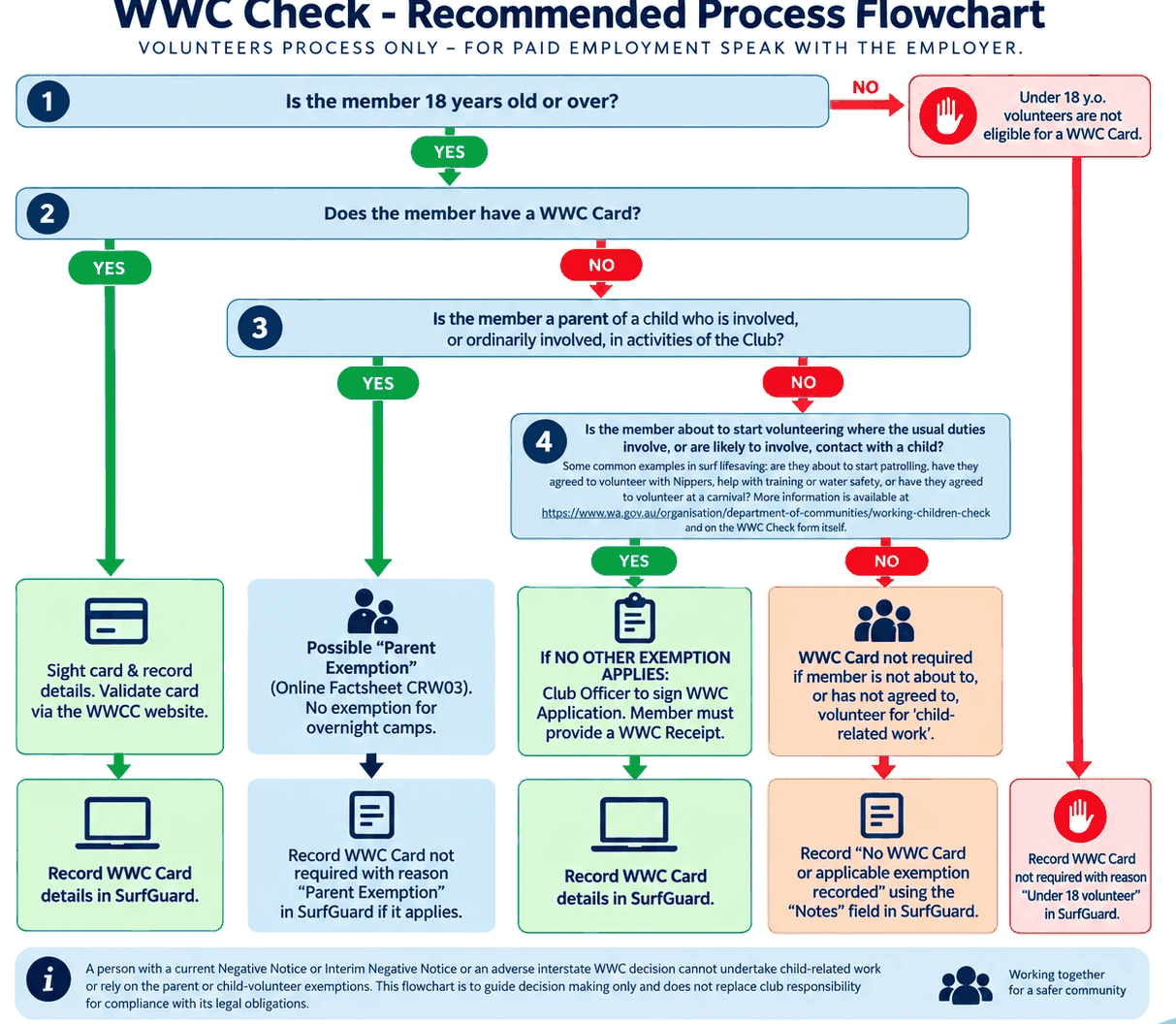
Flowchart: Surf Life Saving WA. It covers volunteers only — for paid employment, speak with your employer.
Applying for a WWC Check
Get an application form from the Club or an Australia Post outlet.
Have a Club Officer sign it. The application has to name the organisation you are volunteering for, so it must be signed off by the Club before you lodge it — contact admin@triggisland.com.
Lodge it with your identification. The volunteer fee is currently $11; paid employees pay $85.
Send the Club your receipt. The receipt is what lets you start volunteering while your application is processed — email a copy to admin@triggisland.com.
Send the card when it arrives. The Club sights it, validates it on the WWC website and records the details.
Already hold a card?
Email a copy to admin@triggisland.com along with the details of any child you are associated with at the Club — for example, as a Nipper parent.
The parent exemption
If you are the parent of a child who is involved, or ordinarily involved, in Club activities, you may not need a WWC Check to volunteer alongside them. This is the parent volunteer exemption, explained in the WA Government factsheet CRW03.
Two things to know:
It does not cover overnight camps. If you are volunteering on a camp involving an overnight stay, you need a card.
It is recorded, not assumed. Tell the Club you are relying on it so it can be recorded as “Parent Exemption”, with the duties that were considered.
Keeping it current
A WWC Card has an expiry date. Renew before it lapses and send the Club the new details — an expired card is the same as no card for the duties it covers. If your circumstances change and you take on a new role, let the Club know so your record reflects what you actually do.
Negative Notices
Anyone with a current Negative Notice, Interim Negative Notice, or an adverse interstate WWC decision cannot do child-related work and cannot rely on the parent or child-volunteer exemptions. You must tell the Club immediately if this applies to you, or if you are charged with or convicted of a Class 1 or Class 2 offence. Under SLSWA's Member Screening Policy the Club must act on it straight away, and notify SLSWA.
What the Club does with it
The Club keeps a record for every member showing whether they hold a current WWC Check or do not need one, and why — the duties considered and any exemption relied on. Card details and exemptions are recorded in SurfGuard. This is a condition of affiliation under the SLSWA Member Screening Policy, and the Club is responsible for its own compliance with the Act.
Who to ask
Club records, forms and signing — admin@triggisland.com
SLSWA — mpio@slswa.com.au | (08) 9207 6666
WWC Screening Unit (WA) — checkquery@communities.wa.gov.au | 1800 883 979 | workingwithchildren.wa.gov.au
2.5.2
Photography & Social Media
Updated 23 Sep 2026 · Grant
Two SLSA policies set what members may and may not do with photos, video and social media: 6.20 Social Media and 6.21 Photography, Digital Recording & Images. They apply whenever you are taking images at the Club or on the beach, and whenever you post as a member of Trigg Island SLSC.
Taking photos
Never photograph or film in change rooms or toilets. Phones and cameras do not belong in those spaces.
The clubhouse is private property, so photography can be restricted there — follow any direction from the Club about where and when you can take images.
At carnivals, stay out of the competition arena unless you are an accredited photographer. Photograph from where the public can go.
Photographing children
Get the consent of a parent or guardian before you publish a photo or video of someone else's child.
Don't name children in captions or posts where you can avoid it.
Don't post details about a child — their school, where they train, their likes and dislikes. That information can be used to groom.
Use images that are about the activity, with the child suitably attired. Photos involving minimal clothing or unusual poses can be misused, however innocently they were taken.
Never
Photographing a child in a provocative or offensive way is a criminal matter, whoever the child belongs to. So is using any online platform to groom or inappropriately engage with a child. If you believe a child is at risk, call the police on 000.
Before you post
Consent first. Ask the person in the photo before you publish it. For anyone under 18, ask a parent or guardian.
Someone else's photo is someone else's copyright. Get permission and credit them.
Keep incidents off social media. Nothing about rescues, first aid, patients, or anything else confidential involving members or the public.
Don't use Club or SLS imagery to promote a product, business or service — paid or unpaid — without approval.
What not to post
This applies whether you are posting from a Club account or your own. Members must not post anything obscene, defamatory, threatening, harassing, bullying, discriminatory, offensive, abusive, hateful, racist or sexually explicit, and must not criticise or disparage the Club, other clubs, officials, sponsors, athletes or their people.
Cyberbullying is a member protection matter, not just bad manners — see Member Protection.
Respond to others respectfully, keep what you post accurate, correct mistakes promptly, and don't express political affiliations on an account clearly associated with surf life saving.
Your own accounts
If your account identifies you as a member — in your bio, your photos, your posts — you are accountable for what you put there, and these policies apply.
A personal account can mention the Club, as long as the affiliation is not the main thing the account is about and you make clear the views are your own. Something like: “Trigg Island SLSC member. Opinions are my own and do not represent the Club or Surf Life Saving.”
Only authorised accounts represent the Club itself. If you want to set up an account for a team, squad or event, talk to the Club first.
If something isn't right
A child at risk — police, 000.
A breach of these policies — report it at complaints.sls.com.au.
Something involving a member at Trigg — speak with the Club's MPIO. See Member Protection.
Misuse of social media or images can lead to disciplinary action under the Club's and SLSA's codes of conduct.
2.6
Insurance & Cover
Updated 15 Aug 2026 · Content
SLSA Personal Accident Insurance
Financial members registered under an eligible SLSA membership category are covered by the SLSA Personal Accident Insurance Policy while taking part in authorised club activities. This is maintained by SLSWA on behalf of member clubs and offsets some medical costs and loss of income from an injury sustained during authorised activities.
It doesn't cover everything
SLSA Personal Accident Insurance does not provide 100% coverage for all potential losses. SLSWA strongly recommends all members maintain their own private health insurance and consider additional cover such as income protection.
Club Public Liability Insurance
Community membership categories (Gym, Social) aren't covered by SLSA Personal Accident Insurance. Instead, you're covered by the Club's public liability insurance while on club premises or taking part in club-organised activities. Ask the Club Administrator for specific coverage details.
Silver Salties — special provision
Silver Salties members are covered by SLSA Group Cover Personal Accident Insurance while taking part in authorised Silver Salties activities — a separate arrangement from standard SLSA personal accident insurance.
2.7
Using the Club Gym
Updated 15 Aug 2026 · Content
The gym is available to members aged 16 and over as part of a Gym membership, or as an entitlement of certain other categories (see Membership Categories & Fees).
⚠ To be confirmed
The specific conditions of entry for gym use haven't been finalised in the source policy yet. Check with the Club Administrator for the current gym access requirements before your first session.
2.8
Silver Salties
Updated 20 Aug 2026 · Cas
Silver Salties is Surf Life Saving Australia's program for older Australians — physical activity, social connection, and a way to be part of the surf lifesaving community, whatever your fitness level. At Trigg Island, Silver Salties is a low cost, social and physical program for members aged 65 and over, run year-round.
What's on offer
Tech-savvy sessions — help with social media, Microsoft Office and staying safe online
Weekly walking groups, and yoga classes in the club hall during the cooler months
Inside or Beach fitness circuits all year round, followed by refreshments at the Club
Swimming lessons and squad
A national initiative
Silver Salties is managed by Surf Life Saving Australia, promoted by SLSWA, and delivered locally by clubs like Trigg Island. It's supported by Sport Australia's Move It — Better Ageing Grant program. While Silver Salties targets members aged 65+, adults 18+ are welcome to take part.
Membership & insurance
Silver Salties is one of the Club's Community membership categories (see Membership Categories & Fees) — $150 for the season. Silver Salties members are covered by SLSA Group Cover Personal Accident Insurance while participating in authorised Silver Salties activities — a specific arrangement separate from standard SLSA personal accident insurance (see Insurance & Cover).
Getting involved
For more information or to register, contact Rene via admin@triggisland.com, or call the Club on 08 9447 3556.