Full Handbook
Printed 11 October 2026
1. Welcome
1.1
Welcome to Trigg Island SLSC
Updated 8 Oct 2026 · Grant
Finding your way around
This handbook has several chapters and topics. On mobile, tap the ☰ menu icon in the top-left corner to open the chapter list — it's tucked away by default to save space. On a larger screen, the chapter list is already open on the left.
Trigg Island Surf Life Saving Club has proudly patrolled our stretch of coast for generations, keeping the community safe while building lifelong skills, friendships and a genuine love of the ocean. Whether you're brand new to the club or have been a member for years, this handbook is your go-to reference for everything from patrol rosters to uniform requirements.
Our purpose
We exist to prevent drowning and promote water safety, while developing confident, capable young people and adults through surf sports, lifesaving training and community involvement. Our motto — Save Lives, Develop Lives — sits at the heart of everything we do.
What's in this handbook
Membership categories, benefits, fees and how to join
Patrol rosters and lifesaving obligations
Nippers and Youth program information
Surf Sports training and competition details
Club policies and codes of conduct
If you can't find what you're looking for, reach out to the club via the contacts listed in the next topic.
1.2
Our Values
Updated 22 Aug 2026 · Rochelle
Trigg Island SLSC's purpose, vision and values sit at the heart of our Strategic Plan 2025–30, Our Island, Our Future — a five-year roadmap to strengthen lifesaving, develop people, and grow our community impact.
Our purpose
Save lives, develop lives.
Our vision
To protect life and develop inclusive communities.
Our values
Teamwork
Care
Respect
Our strategic pillars
The next five years focus on four strategic pillars that guide our priorities and growth, aligned with our purpose and values:
Save lives
Develop & support people
Grow and sustain our club
Engage the community
Our lens
Every decision and initiative over the next five years is guided by:
Acting as custodians of our precinct and environment
Collaborating, listening and adapting
Ensuring equity, inclusion and belonging
Measuring impact and building with legacy
Being bold and future-focused
1.3
Getting Involved & Key Contacts
Updated 4 Oct 2026 · Carolyn
Whatever question you have, there's a good chance someone at the club already knows the answer. Here's who to contact, and how to get more involved.
General enquiries
Member and Community Administrator — Rene Venoutsos, admin@triggisland.com | 08 9447 3556
Address — 360 West Coast Drive, Trigg WA 6029
Club leadership
Role | Name | Contact |
|---|---|---|
President | Cas Ryan | president@triggisland.com |
Vice President | Grant Rosman | education@triggisland.com |
Director of Membership | Rochelle McKee | membership@triggisland.com |
Director of Finance and Administration | Mark Doick | finance@triggisland.com |
Director of Surf Sports | Jeremy Hunter | surfsports@triggisland.com |
Director of Lifesaving | Paul Roberts | lifesaving@triggisland.com |
Director of Education | Grant Rosman | education@triggisland.com |
Director of Nippers | Lauren Robertson | nippers@triggisland.com |
Director of Youth | Kirk Phillips | youth@triggisland.com |
Appointed Director | Paul Burton | pburton@triggisland.com |
Staff
Role | Name | Contact |
|---|---|---|
Member and Community Administrator | Rene Venoutsos | admin@triggisland.com |
Head of Athlete Development and Coaching | Andrew Mosel | amosel@triggisland.com |
Training & award coordinators
Role | Contact |
|---|---|
Bronze Training Coordinator | bronze@triggisland.com |
SRC Training Coordinator | src@triggisland.com |
NRC Training Coordinator | nrc@triggisland.com |
Medical Awards Training Coordinator | medicalawards@triggisland.com |
Powercraft Training Coordinator | powercraft@triggisland.com |
Drone Training Coordinator | drones@triggisland.com |
Skills Maintenance Coordinator | proficiency@triggisland.com |
⚠ To be confirmed
Patrol Training Coordinator and TAF Coordinator don't have a listed contact yet — reach the Club Administrator in the meantime.
Lifesaving & Youth officers
Role | Contact |
|---|---|
Patrol Officer | patrolofficer@triggisland.com |
Powercraft Officer | powercraft@triggisland.com |
U/14 Officer | u14@triggisland.com |
U/15 Officer | u15@triggisland.com |
U/17 Officer | u17@triggisland.com |
⚠ To be confirmed
Youth Development doesn't have a listed contact yet.
Nipper age group contacts
Age group | Contact |
|---|---|
Under 6 | u6@triggisland.com |
Under 7 | u7@triggisland.com |
Under 8 | u8@triggisland.com |
Under 9 | u9@triggisland.com |
Under 10 | u10@triggisland.com |
Under 11 | u11@triggisland.com |
Under 12 | u12@triggisland.com |
Under 13 | u13@triggisland.com |
Member Protection Information Officers (MPIOs)
Cas Ryan, Hayden Marchetto and Sophie Lawson are the Club's trained MPIOs — a confidential first point of contact for any concern about conduct, welfare, child safety or harassment. Reach any of them via admin@triggisland.com. See Complaints, Grievances & Discipline for more on how this works.
Getting involved
Trigg Island Surf Life Saving Club is volunteer-led — from patrol, to Sunday Nippers, to committees and events, there's a role that fits almost any amount of time you can give. Reach out to any Director or Coordinator above for the area you're interested in, or start with the Club Administrator if you're not sure who to ask.
1.4
Member Benefits
Updated 23 Aug 2026 · Grant
What do you get for your membership?
Every Trigg Island membership comes with access to our programs, facilities and social calendar — plus discounts from the businesses that support the Club.
Membership benefits
Nippers
Nipper program (Sunday AM program)
Coaching, water safety and skill development
Use of club equipment
Access to Nipper Surf Sports training sessions
Access to and discounted hire of club rooms
Social events
Equipment storage (additional fee)
Access to discounts from sponsors
Active / Cadet
Surf sports program with professional coaching and skill development
Use of club equipment
Access to gym and cardio equipment (16+ years)
Access to and discounted hire of club rooms
Social events
Equipment storage (additional fee)
Access to discounts from sponsors
Gym
24/7 access to gym facility
Access to discounts from sponsors
Social
Access to social events at the club
Access to member's food and drink prices
Access to discounts from sponsors
Member discounts
Available for Our Island family.
Diamond High Performance

Our Performance Partner offers gym access, strength & conditioning, performance training, recovery and more. Trigg members receive exclusive discounts across selected memberships. Contact the Diamond HP team for current member offers.
B&E Fire Protection

Long-standing Club partner B&E Fire Protection provides integrated fire protection services across commercial, residential, education, health and industrial projects. For fire protection needs, support the local team that supports Trigg.
Realty Lane

Local real estate specialists Daniel and Maria Gonzalez and the Realty Lane team have proudly supported Trigg since 2021. Thinking of selling, buying or simply curious about your property's value? Let them know you're part of the Trigg family.
Morley Mitsubishi

Morley Mitsubishi proudly supports our lifesaving operations and provides the Club with significant assistance towards our beach vehicle. Looking for a new or pre-owned vehicle? Support the dealership that supports Our Island.
MBH Accounting & Taxation Services

MBH Accounting & Taxation Services have supported Trigg for more than 20 years. For accounting, taxation and financial advice you can understand, consider the team that continues to support our Club and Surf Sports programs.
Give IT

Our trusted IT partner for more than a decade, Give IT provides technology and IT support to keep the Club connected. For business IT, cloud solutions and technology support, consider the team that supports Trigg.
St Mary's Anglican Girls' School
A valued part of our local community, St Mary's continues to generously support Trigg Island SLSC and our members. We're proud to partner with a school that shares our commitment to community and developing young people.
Betty's Burgers

Betty's Burgers supports Trigg through both financial and delicious in-kind contributions. Next time you're craving a burger, support one of the businesses that proudly supports Our Island.
Hollow Surf

Our local surf specialists at Hollow Surf offer Trigg members 15% off in-store all year round. Visit the team at North Beach or Hillarys and let them know you're a Trigg Island member.
UBX Scarborough

Get moving with our local UBX team. Trigg members can access discounted weekly memberships – saving up to $15 per week – plus 3 trial sessions for just $5. Ask UBX Scarborough for the Trigg member rate.
Perth Signcraft & Graphics

Perth Signcraft & Graphics provides the Club with generously discounted signage services throughout the year. For signage, graphics and branding needs, consider supporting the team that supports Trigg.
Neighbourhood Plumbing & Gas

For plumbing, gas and water filtration needs, look no further than our local partners at Neighbourhood Plumbing & Gas. Trigg Island members can access discounted rates on their services – simply let the team know you're part of the Trigg family when getting in touch.
DrimTel

Mobile and NBN with a difference. DrimTel donates 50% of profits to Type 1 Diabetes research. Use code TISLSC for 50% off your first 3 months, plus selected Trigg merchandise offers when signing up or bundling eligible plans.
New Balance / Belgravia Apparel

Trigg members can access an exclusive 30% discount through the New Balance Australia online store during a dedicated member weekend each year. Keep an eye on Club communications for dates and access details.
West Coast Health Physio

Need help getting back to your best? Trigg members can access heavily discounted physiotherapy fees through West Coast Health Physio. Simply let the team know you're a member and ask for the Trigg Family Rate.
Current sponsors
Backed by great brands. Driven by community.
 |  |  |
 |  |  |
 |  |  |
 |  |  |
 |  |  |
 |  |  |
 |  |  |
 |  |
Please support those who support us
Our partners play an important role in helping Trigg Island SLSC Save Lives, Develop Lives and continue delivering programs, services and opportunities for our members and community.
Where you can, we encourage our members and families to support the businesses and organisations that support #OurIsland. Whether you're buying a product, booking a service or simply recommending them to family and friends, your support helps us continue building strong, long-term partnerships that benefit the entire Club.
When you support our partners, you're supporting Trigg.
1.5
Make Your Own Calendar
Updated 30 Aug 2026 · Grant
What this is for
The club calendar holds every event of the season — patrols, Nippers, carnivals, courses and social nights. If you only care about some of it, you can narrow it down and save just those events as a PDF to print or keep on your phone.
The example below makes a calendar showing only Nippers and Social events. The same steps work for any combination.
Step 1 — open the calendar
Go to the club calendar. You will see every event for the month, and a button marked Filters.
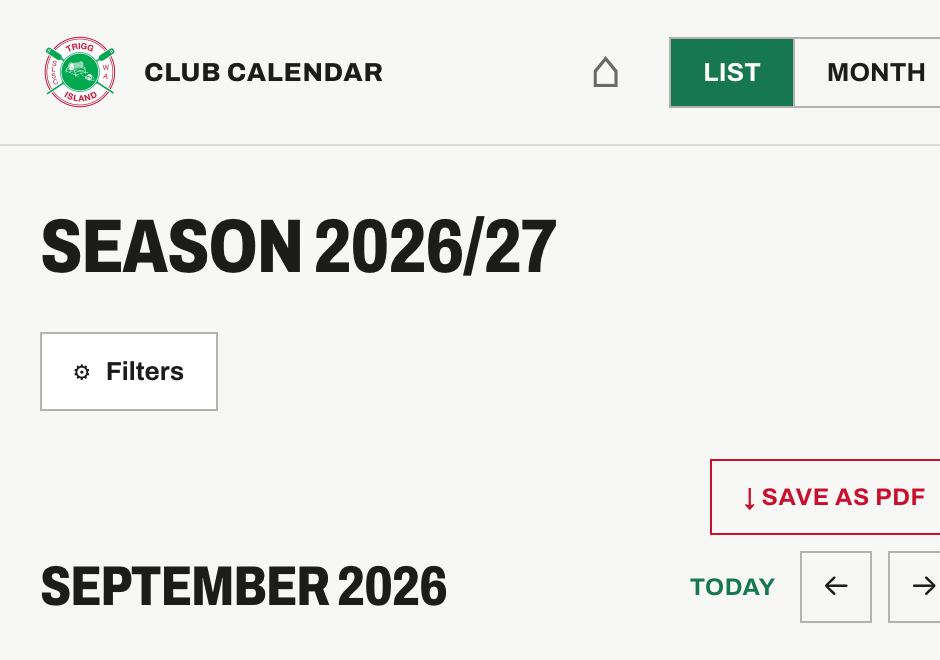
Step 2 — tap Filters and choose what you want
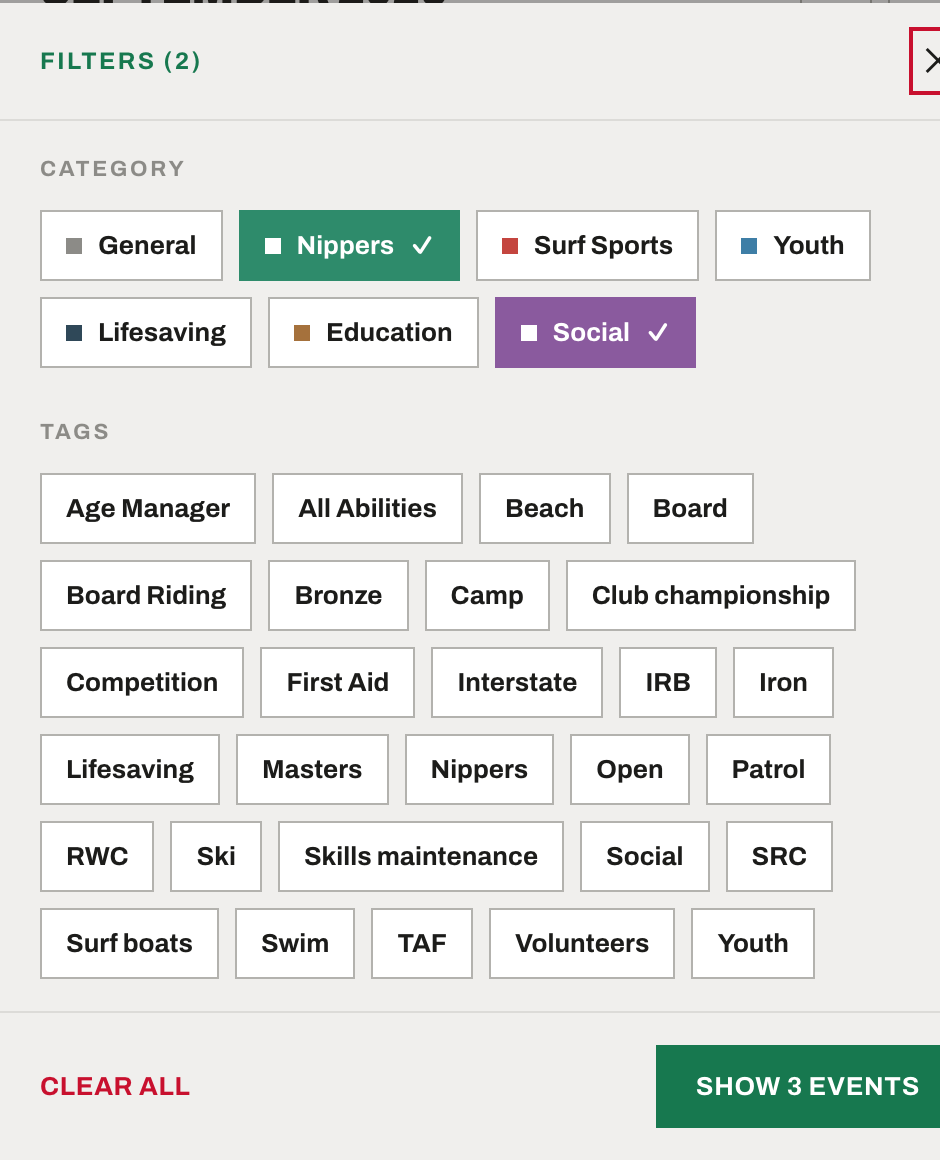
Tap Filters. A panel slides up listing every type of event. Tap Nippers and Social — they turn coloured with a tick to show they are on.
Tip
The green button at the bottom counts as you go — here it reads Show 9 events. That is how many you will get. Tap it when you are happy.
Step 3 — check the list looks right
The calendar now shows only the events you asked for. The Filters button carries a number so you can see a filter is on.
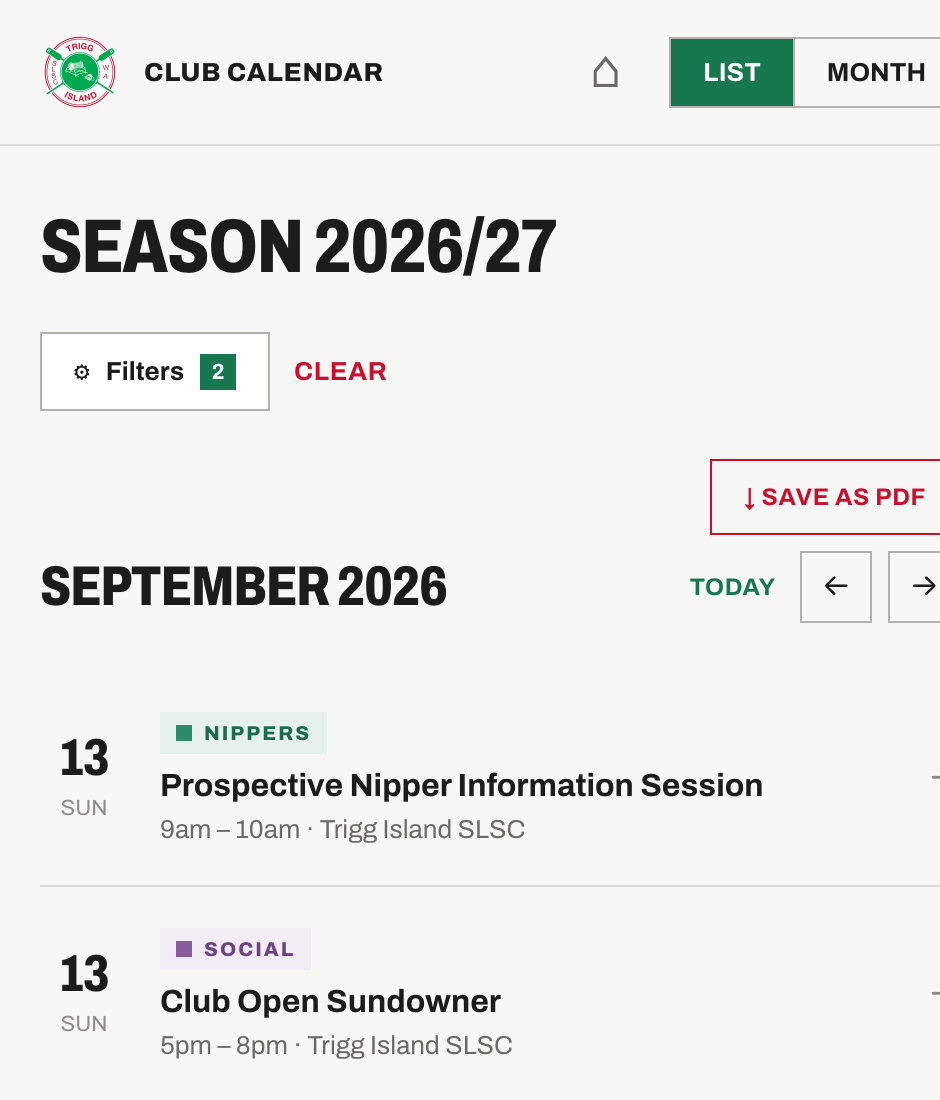
Changed your mind? Tap Clear next to the Filters button to go back to everything.
Step 4 — save it as a PDF
Tap Save as PDF. You will be asked how much of the season you want.
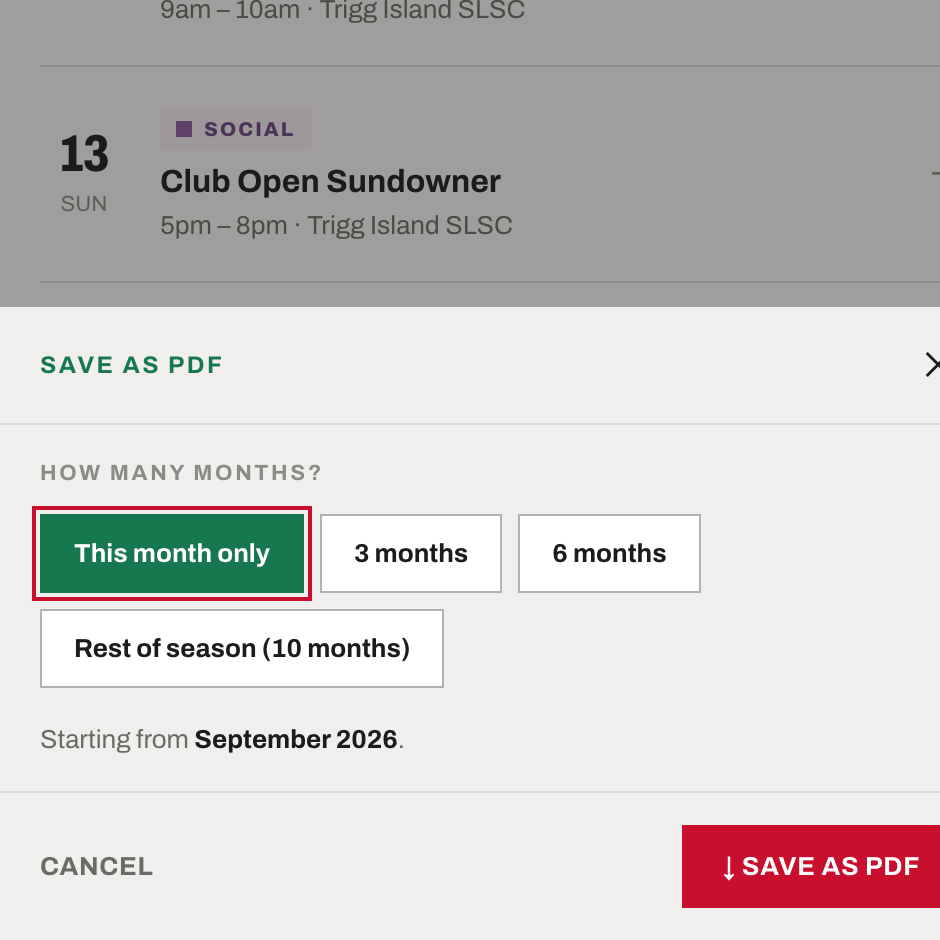
This month only — just the month you are looking at
3 months or 6 months — starting from that month
Rest of season — everything from that month to the end
Choose one, then tap Save as PDF again. Your phone or computer will ask where to keep the file — on an iPhone choose Save to Files, and on a computer pick Save as PDF as the printer.
What you end up with
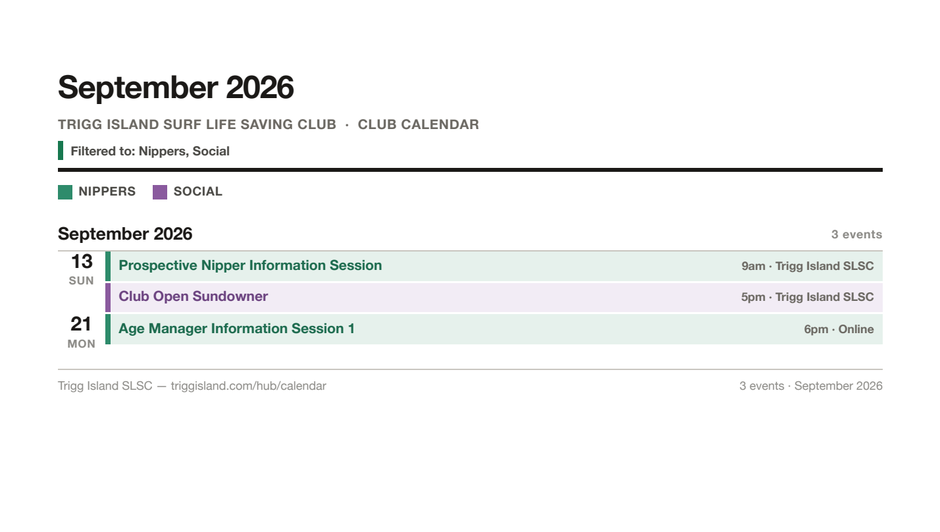
A clean sheet with the date, event name, start time and location — colour-coded, and with a line at the top recording which filters you used.
Worth knowing
You can also filter by tag — things like Bronze, Camp or Skills maintenance — in the same panel, underneath the categories. And on a computer the filters sit along the top of the page instead of behind a button, but they work exactly the same way.
1.6
Add the Hub to Your Phone
Updated 30 Aug 2026 · Grant
What this does
You can put the Hub on your phone's home screen so it opens with one tap, like a normal app — full screen, with no address bar in the way. There is nothing to download and nothing to pay for; it is the same website, just easier to get to.
Follow the section for your phone. The pictures below show what to look for — your screen may not look exactly the same, as phones differ, but the buttons are named the same.
iPhone and iPad
You must use Safari for this. It will not work in Chrome on an iPhone.
1. Tap the Share button
It is in the bar at the bottom of the screen and looks like a square with an arrow pointing up out of it.
2. Choose Add to Home Screen
A grey list slides up. Scroll down it until you find Add to Home Screen.
3. Tap Add
You can change the name first if you like. Then tap Add in the top corner.

Android
These steps are for Chrome, which most Android phones use.
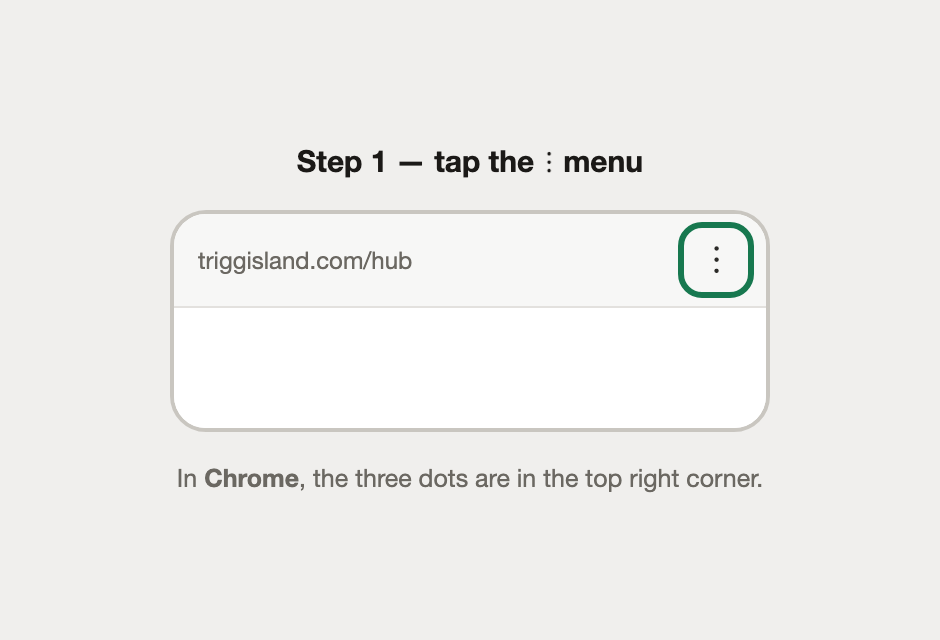
1. Tap the three-dot menu
It sits in the top right corner, next to the web address.
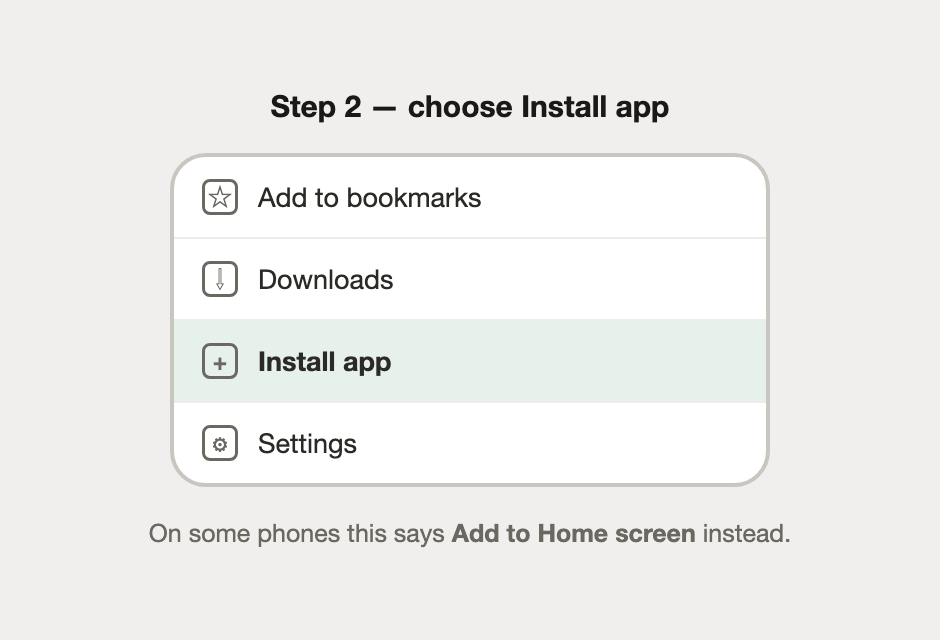
2. Choose Install app
Some phones word this as Add to Home screen instead. Either is the right one.
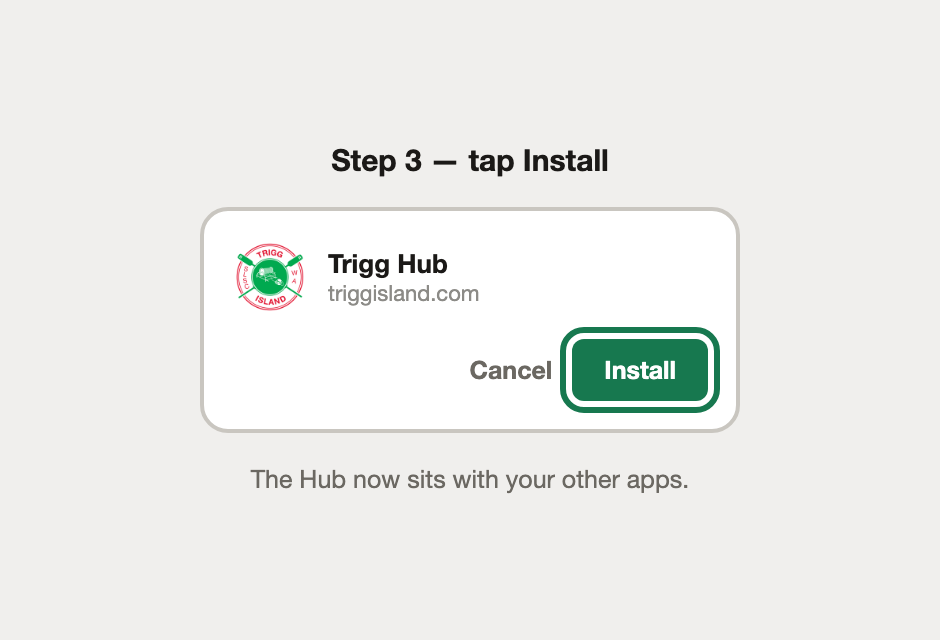
3. Tap Install
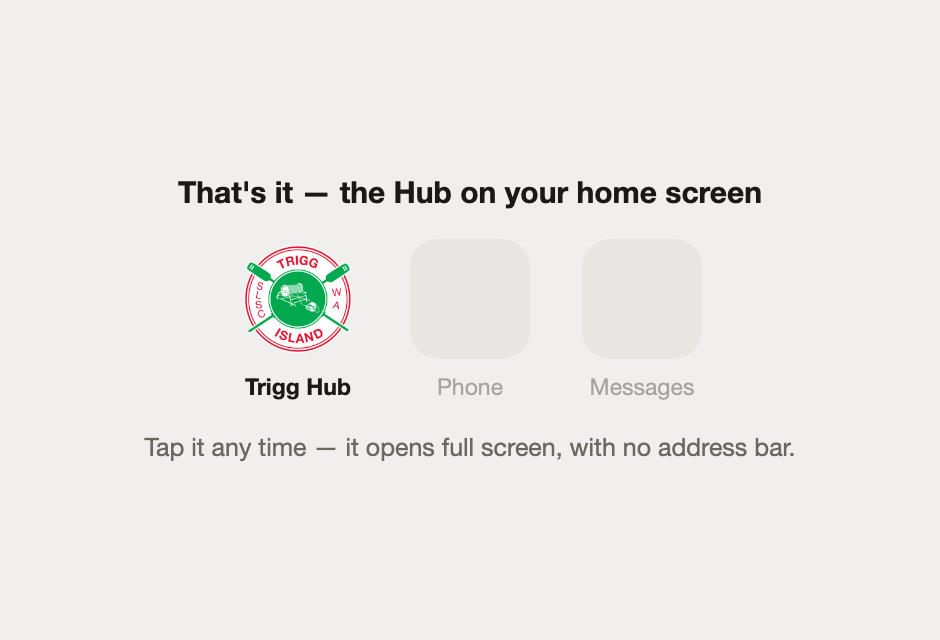
You are done
The Trigg Hub icon now sits with your other apps. Tap it any time to open the handbook and calendar.
Tip
The Hub may offer to do this for you — if a green bar appears at the bottom of the screen inviting you to add it, you can simply tap that instead of following the steps above.
Please note
The Hub still needs an internet connection to load. Adding it to your home screen makes it quicker to reach, but it does not store the handbook on your phone for use offline.
2. Membership
2.1
Membership Categories & Fees
Updated 22 Aug 2026 · Rochelle
Age reference date
Your (or your child's) age for membership category purposes is your age on 30 September in the year the season starts. For the 2026–27 season, the reference date is 30 September 2026. Example: a member who is six years old on 30 September 2026 will enrol in Junior Activity U7.
Trigg Island SLSC offers a category for almost every way of being involved, from five-year-old Nippers through to Life Members. This page is a plain-language summary — the full detail sits in the Club's Membership Policy (MEM-001).
Junior members (Nippers)
Category | Age | Notes |
|---|---|---|
Junior Activity (U6–U7) | Under 8 | Play, participation and fun. Must be accompanied by a financial Nipper Parent. |
Junior Activity (U8–U13) | 8–13 years | Core Nipper program; progresses through Surf Education Certificates each year. |
Adaptive / Inclusive Program | 5–99 years | Adapted curriculum for participants of All Abilities, determined case by case. |
Every Nipper needs at least one parent or guardian registered as a Nipper Parent member — without one, the Nipper registration can't be finalised.
Cadet members (13–15 years)
Cadets hold the Surf Rescue Certificate and begin patrol duties: a minimum of 16 hours a season at U14, and a full patrol roster at U15. Annual Skills Maintenance is due by 31 December.
Active members
Active membership is the operational core of the club — Bronze Medallion holders who patrol, vote, compete and can hold office. This covers Active (15–18), Active (18+), Active Reserve (available after 8+ years of satisfactory service, by application) and Award Members (hold a patrolling award short of the full Bronze Medallion, such as Radio or First Aid). A one-off Bronze Levy applies the first time you join as Active or Probationary without already holding a Bronze Medallion.
Probationary and Associate members
Probationary membership (18+) is for members actively working toward their Bronze Medallion. Associate categories — Associate General and Nipper Parent, and Leave/Restricted Member — support parents and members on approved leave, without patrol obligations.
Honorary, Service and Community members
Life Member and Long Service categories recognise long-term contribution and are granted by Board resolution. Community categories — Gym, Silver Salties and Social — are for people who want to use specific facilities or join in club life without becoming an operational lifesaver, and are covered by the Club's public liability insurance rather than SLSA personal accident insurance.
Membership fees
Category | Season cost |
|---|---|
Junior Activity (U6–U13) | $190 |
Cadet (13–15 years) | $215 |
Adaptive (All Abilities) | $80 |
Active (15–18 years) | $230 |
Active (18+), Active Reserve, Award, Long Service | $230 |
Nipper Parent | $130 |
Gym | $450 |
Silver Salties | $150 |
Community | $130 |
One-off fees also apply for board/ski rack storage ($75 / $95) and completing a Bronze Medallion ($100).
Payment deadline
Fees cover 1 October to 30 September and are due by 30 September each season. Unpaid fees can mean suspension from patrol, club activities and facility access until payment is confirmed.
Family fee cap
Once a family reaches the Family Membership Fee Cap, no further base membership fees apply for eligible family members that season. A family is up to two adults plus any number of dependent children in Junior Activities, Adaptive or Active (15–18) categories. The cap covers base fees only — course fees (including the Bronze Levy), equipment storage and competition entry fees are always payable separately. Contact the Club Administrator to apply the cap when registering.
2.2
Joining & Renewing Your Membership
Updated 22 Aug 2026 · Rochelle
All registrations and renewals happen through the SLSA Members Hub — the national online membership platform — at hub.sls.com.au.
New members
- Create a personal account at hub.sls.com.au (a parent or guardian must create the account for a child).
- Search for and select Trigg Island Surf Life Saving Club.
- Choose the membership category that applies to you or your child.
- Complete your details and submit any required documents — proof of age (birth certificate or passport) for Junior members, and a Working With Children Check for Nipper Parents and anyone working with children.
- Pay your fees.
- Wait for the Club Administrator to approve your application — you're not a financial member, and can't train, patrol or compete, until it's approved and confirmed.
Joining to do your Bronze Medallion?
Select Probationary as your category — the Bronze Levy is included in the Probationary fee.
Returning members
Renew each season from 1 July, once the new season's fees are published. If you've set up a Family Group in the Hub, the primary account holder can renew everyone together — each person still keeps their own individual record.
Season timeline
| Date | Milestone |
|---|---|
| 1 July | Fee schedule approved; renewal portal opens |
| 1 September | Seasonal call for renewals and new registrations begins |
| 30 September | Prior season membership expires; age reference date |
| 1 October | Fees due; patrol season commences |
| 31 December | Deadline for annual Skills Maintenance (patrolling members) |
2.3
The SLS Members Hub
Updated 17 Aug 2026 · Grant
The SLS Members Hub (hub.sls.com.au) is the national online platform Surf Life Saving Australia uses for membership, awards, patrols and communication — every SLS club in the country runs on it, including Trigg Island. Each financial member has their own individual login; a parent or guardian creates and manages the account for a child.
What you can do in the Hub
Join or renew — register a new membership, or renew each season from 1 July, including as part of a Family Group
Manage your patrols — view your roster and patrol hours (Patrols > Patrol Roster), and request or accept a patrol swap (Patrols > Patrol Swap) — see Can't Make a Patrol? in Patrols & Lifesaving
Complete training — work through Skills Maintenance eLearning modules, and register for courses and practical assessment sessions
Check your awards — view your current awards and proficiency status, recorded in Surfguard
Access the Document Library — SLSA and SLSWA policies, circulars and step-by-step user guides
Update your details — keep your contact details, emergency contacts, medical information and Working With Children Check record current
Raise a formal complaint — lodge a matter through the SLS Reporting System where that's the right pathway — see Complaints, Grievances & Discipline
Transfer clubs — start an SLSA club transfer if you're moving to or from Trigg Island
Trouble logging in?
Contact the Club Administrator — admin@triggisland.com | 08 9447 3556 — for help accessing or setting up your Hub account.
2.4
Member Rights & Responsibilities
Updated 15 Aug 2026 · Content
Your rights as a member
- Participate in club activities appropriate to your membership category
- Access club facilities in line with club policy and the By-Laws
- Access training and development opportunities relevant to your category
- Attend and speak at general meetings
- Vote at general meetings (Active, Active Reserve, Award if patrolling, Long Service and Life Members, subject to compliance requirements)
- Nominate for elected positions where eligible under the Constitution
- Compete in surf sports events where eligible under SLSA and club rules
Code of Conduct
All members must follow the SLSA Code of Conduct, part of the SLSA Member Protection Policy (Policy 6.05). You formally acknowledge this each season when you renew, and failing to observe it can be treated as misconduct.
Working with children and young people
If you work with, supervise or interact with anyone under 18 in a club context — Nippers, patrol, coaching, officiating — you must also follow the SLSA Code of Conduct for engagement with Children and Young People: treat them with respect and dignity, keep appropriate professional boundaries, never be alone with them in circumstances that could be misread, and report any welfare concern to the Club's MPIO immediately.
See Complaints, Grievances & Discipline for how to raise a concern if you experience or witness a breach.
2.5
Member Protection
Updated 23 Sep 2026 · Content
Trigg Island SLSC is committed to providing a safe, fair and inclusive environment for everyone involved in the Club. Member protection is governed by Surf Life Saving Australia's Member Protection Policy (SLSA Policy 6.05), which sets out the Code of Conduct and protections that apply to every member, volunteer, official and participant.
What the policy covers
SLSA Policy 6.05 — Member Protection sets behavioural standards for all members and provides a framework for preventing and responding to discrimination, harassment and abuse. It works alongside:
- SLSA Policy 6.04 — Child Safe Policy, and the Child Safe Code of Conduct — specific behavioural standards for anyone working with children and young people (under 18) in a Club context, such as Nippers, coaching, or officiating
- SLSA Policy 6.06 — Complaints Resolution — the formal process for handling breaches; see Complaints, Grievances & Discipline for how this works at Trigg Island
Working with children
Anyone volunteering or working with members under 18 at Trigg Island — Nippers, Youth, coaching, water safety, patrols — needs a current Working with Children (WWC) Check, unless an exemption applies. Working With Children explains who needs one, how to apply, the parent exemption, and what to send the Club.
Reporting a concern
How you report depends on the nature of the concern:
- Immediate risk to a child — contact Police on 000 first
- Child Safe Policy breach — report through the SLS Reporting System
- Any other member protection concern — speak with the Club's MPIO first
See Complaints, Grievances & Discipline for the full picture of how concerns are handled at Trigg Island, and Getting Involved & Key Contacts for the Club's current MPIOs.
More information
For state-wide member protection guidance, contact the SLSWA Member Development Coordinator — dsomers@slswa.com.au | (08) 9207 6666 — or visit mybeach.com.au.
2.5.1
Working With Children
Updated 23 Sep 2026 · Grant
Most roles at the Club count as child-related work under Western Australia's Working with Children (Screening) Act 2004 — patrolling, Nippers, coaching, training, water safety and carnivals all bring you into contact with children. This page walks you through whether you need a Working with Children (WWC) Check, how to get one, and what to send the Club.
The short version
If you are 18 or over and about to start any duty that involves contact with children, you need a WWC Check — unless the parent exemption applies to you. Send your card or receipt to admin@triggisland.com and the Club records it.
Do you need one?
Work down these four questions. The flowchart below is the same set of questions in picture form.
Are you 18 or over? If not, stop here — under-18 volunteers are not eligible for a WWC Card. The Club records you as an “Under 18 volunteer” and there is nothing for you to do until you turn 18.
Do you already hold a WWC Card? If yes, send it to the Club. We sight it, validate it on the WWC website, and record the details. Nothing else is needed.
Are you the parent of a child who is involved in Club activities? If yes, the parent exemption may apply to you — see below.
Are you about to start duties that involve contact with children? If yes and no exemption applies, you need to apply. If no — you are not about to take on, and have not agreed to take on, child-related work — you do not need a card, and the Club records that.
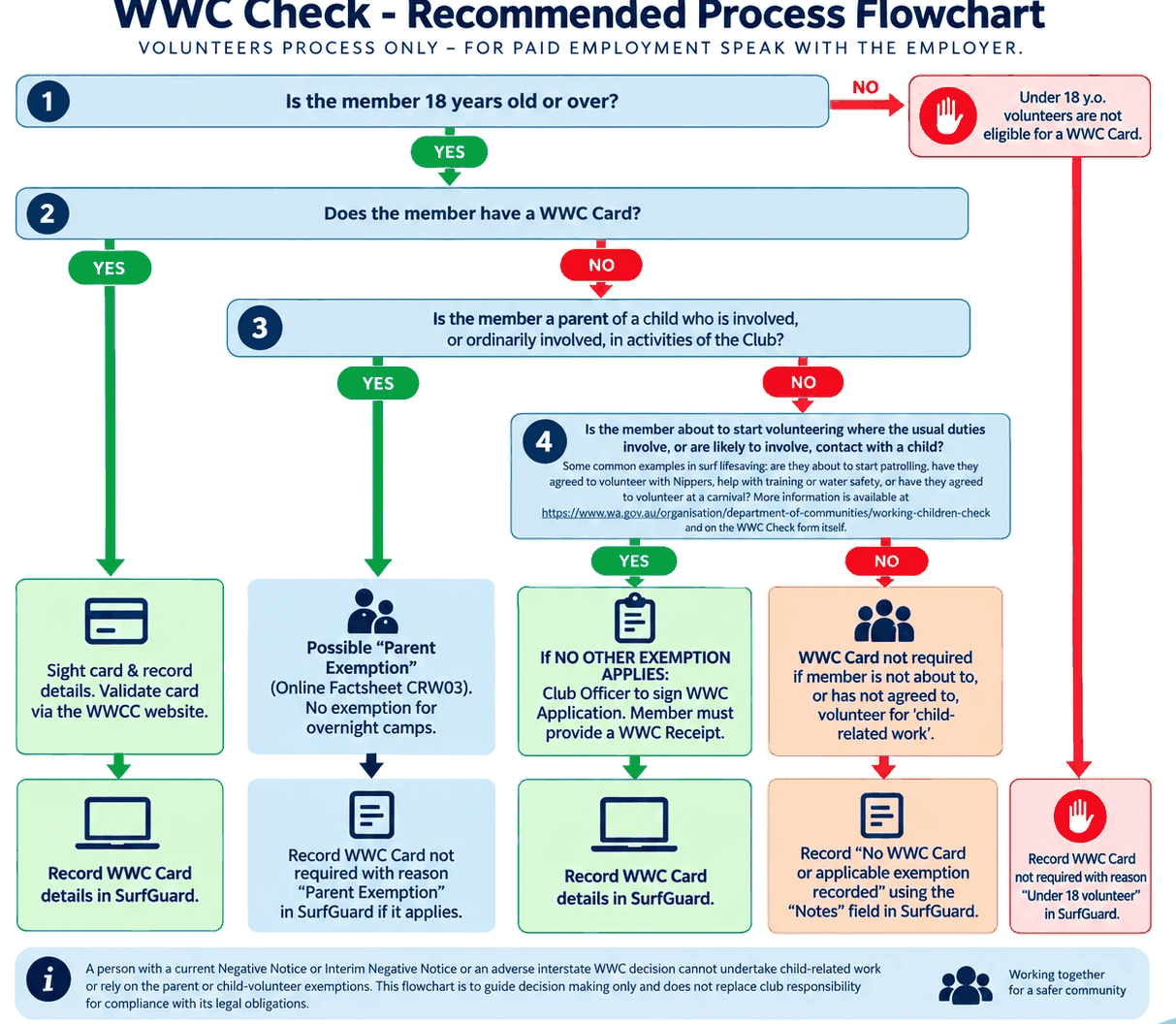
Flowchart: Surf Life Saving WA. It covers volunteers only — for paid employment, speak with your employer.
Applying for a WWC Check
Get an application form from the Club or an Australia Post outlet.
Have a Club Officer sign it. The application has to name the organisation you are volunteering for, so it must be signed off by the Club before you lodge it — contact admin@triggisland.com.
Lodge it with your identification. The volunteer fee is currently $11; paid employees pay $85.
Send the Club your receipt. The receipt is what lets you start volunteering while your application is processed — email a copy to admin@triggisland.com.
Send the card when it arrives. The Club sights it, validates it on the WWC website and records the details.
Already hold a card?
Email a copy to admin@triggisland.com along with the details of any child you are associated with at the Club — for example, as a Nipper parent.
The parent exemption
If you are the parent of a child who is involved, or ordinarily involved, in Club activities, you may not need a WWC Check to volunteer alongside them. This is the parent volunteer exemption, explained in the WA Government factsheet CRW03.
Two things to know:
It does not cover overnight camps. If you are volunteering on a camp involving an overnight stay, you need a card.
It is recorded, not assumed. Tell the Club you are relying on it so it can be recorded as “Parent Exemption”, with the duties that were considered.
Keeping it current
A WWC Card has an expiry date. Renew before it lapses and send the Club the new details — an expired card is the same as no card for the duties it covers. If your circumstances change and you take on a new role, let the Club know so your record reflects what you actually do.
Negative Notices
Anyone with a current Negative Notice, Interim Negative Notice, or an adverse interstate WWC decision cannot do child-related work and cannot rely on the parent or child-volunteer exemptions. You must tell the Club immediately if this applies to you, or if you are charged with or convicted of a Class 1 or Class 2 offence. Under SLSWA's Member Screening Policy the Club must act on it straight away, and notify SLSWA.
What the Club does with it
The Club keeps a record for every member showing whether they hold a current WWC Check or do not need one, and why — the duties considered and any exemption relied on. Card details and exemptions are recorded in SurfGuard. This is a condition of affiliation under the SLSWA Member Screening Policy, and the Club is responsible for its own compliance with the Act.
Who to ask
Club records, forms and signing — admin@triggisland.com
SLSWA — mpio@slswa.com.au | (08) 9207 6666
WWC Screening Unit (WA) — checkquery@communities.wa.gov.au | 1800 883 979 | workingwithchildren.wa.gov.au
2.5.2
Photography & Social Media
Updated 23 Sep 2026 · Grant
Two SLSA policies set what members may and may not do with photos, video and social media: 6.20 Social Media and 6.21 Photography, Digital Recording & Images. They apply whenever you are taking images at the Club or on the beach, and whenever you post as a member of Trigg Island SLSC.
Taking photos
Never photograph or film in change rooms or toilets. Phones and cameras do not belong in those spaces.
The clubhouse is private property, so photography can be restricted there — follow any direction from the Club about where and when you can take images.
At carnivals, stay out of the competition arena unless you are an accredited photographer. Photograph from where the public can go.
Photographing children
Get the consent of a parent or guardian before you publish a photo or video of someone else's child.
Don't name children in captions or posts where you can avoid it.
Don't post details about a child — their school, where they train, their likes and dislikes. That information can be used to groom.
Use images that are about the activity, with the child suitably attired. Photos involving minimal clothing or unusual poses can be misused, however innocently they were taken.
Never
Photographing a child in a provocative or offensive way is a criminal matter, whoever the child belongs to. So is using any online platform to groom or inappropriately engage with a child. If you believe a child is at risk, call the police on 000.
Before you post
Consent first. Ask the person in the photo before you publish it. For anyone under 18, ask a parent or guardian.
Someone else's photo is someone else's copyright. Get permission and credit them.
Keep incidents off social media. Nothing about rescues, first aid, patients, or anything else confidential involving members or the public.
Don't use Club or SLS imagery to promote a product, business or service — paid or unpaid — without approval.
What not to post
This applies whether you are posting from a Club account or your own. Members must not post anything obscene, defamatory, threatening, harassing, bullying, discriminatory, offensive, abusive, hateful, racist or sexually explicit, and must not criticise or disparage the Club, other clubs, officials, sponsors, athletes or their people.
Cyberbullying is a member protection matter, not just bad manners — see Member Protection.
Respond to others respectfully, keep what you post accurate, correct mistakes promptly, and don't express political affiliations on an account clearly associated with surf life saving.
Your own accounts
If your account identifies you as a member — in your bio, your photos, your posts — you are accountable for what you put there, and these policies apply.
A personal account can mention the Club, as long as the affiliation is not the main thing the account is about and you make clear the views are your own. Something like: “Trigg Island SLSC member. Opinions are my own and do not represent the Club or Surf Life Saving.”
Only authorised accounts represent the Club itself. If you want to set up an account for a team, squad or event, talk to the Club first.
If something isn't right
A child at risk — police, 000.
A breach of these policies — report it at complaints.sls.com.au.
Something involving a member at Trigg — speak with the Club's MPIO. See Member Protection.
Misuse of social media or images can lead to disciplinary action under the Club's and SLSA's codes of conduct.
2.6
Insurance & Cover
Updated 15 Aug 2026 · Content
SLSA Personal Accident Insurance
Financial members registered under an eligible SLSA membership category are covered by the SLSA Personal Accident Insurance Policy while taking part in authorised club activities. This is maintained by SLSWA on behalf of member clubs and offsets some medical costs and loss of income from an injury sustained during authorised activities.
It doesn't cover everything
SLSA Personal Accident Insurance does not provide 100% coverage for all potential losses. SLSWA strongly recommends all members maintain their own private health insurance and consider additional cover such as income protection.
Club Public Liability Insurance
Community membership categories (Gym, Social) aren't covered by SLSA Personal Accident Insurance. Instead, you're covered by the Club's public liability insurance while on club premises or taking part in club-organised activities. Ask the Club Administrator for specific coverage details.
Silver Salties — special provision
Silver Salties members are covered by SLSA Group Cover Personal Accident Insurance while taking part in authorised Silver Salties activities — a separate arrangement from standard SLSA personal accident insurance.
2.7
Using the Club Gym
Updated 15 Aug 2026 · Content
The gym is available to members aged 16 and over as part of a Gym membership, or as an entitlement of certain other categories (see Membership Categories & Fees).
⚠ To be confirmed
The specific conditions of entry for gym use haven't been finalised in the source policy yet. Check with the Club Administrator for the current gym access requirements before your first session.
2.8
Silver Salties
Updated 20 Aug 2026 · Cas
Silver Salties is Surf Life Saving Australia's program for older Australians — physical activity, social connection, and a way to be part of the surf lifesaving community, whatever your fitness level. At Trigg Island, Silver Salties is a low cost, social and physical program for members aged 65 and over, run year-round.
What's on offer
Tech-savvy sessions — help with social media, Microsoft Office and staying safe online
Weekly walking groups, and yoga classes in the club hall during the cooler months
Inside or Beach fitness circuits all year round, followed by refreshments at the Club
Swimming lessons and squad
A national initiative
Silver Salties is managed by Surf Life Saving Australia, promoted by SLSWA, and delivered locally by clubs like Trigg Island. It's supported by Sport Australia's Move It — Better Ageing Grant program. While Silver Salties targets members aged 65+, adults 18+ are welcome to take part.
Membership & insurance
Silver Salties is one of the Club's Community membership categories (see Membership Categories & Fees) — $150 for the season. Silver Salties members are covered by SLSA Group Cover Personal Accident Insurance while participating in authorised Silver Salties activities — a specific arrangement separate from standard SLSA personal accident insurance (see Insurance & Cover).
Getting involved
For more information or to register, contact Rene via admin@triggisland.com, or call the Club on 08 9447 3556.
3. Nippers
3.1
About Nippers & Contacts
Updated 8 Oct 2026 · Carolyn
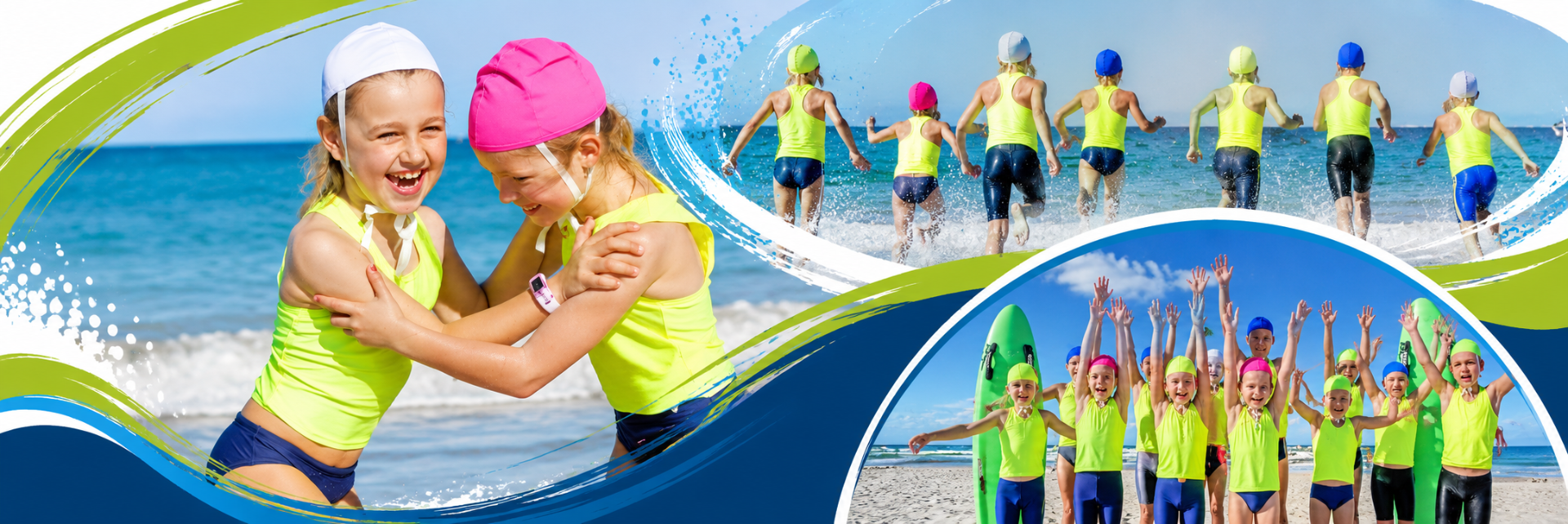
Welcome to another Woodside Nippers season at Trigg Island SLSC! Whether you're brand new or returning, every Sunday morning is designed to be safe, social and full of smiles — for kids and parents alike. Behind the scenes, the program is run by a team of volunteer Age Managers and helpers, many of them parents just like you — the more help they have, the more fun Nippers can have, so please get involved when you can.
At Trigg, we believe fun is the number one reason kids stay active and engaged in sport. That’s why every Sunday morning is designed to be safe, social, and full of smiles — not just for the kids, but for parents too! From beach games to board paddling, there’s something for everyone to enjoy.
Nipper contacts
Role | Name | Contact |
|---|---|---|
Director of Nippers | Lauren Robertson | nippers@triggisland.com |
Nipper Education Coordinator | Jenny Taylor | nrc@triggisland.com |
Nipper Water Safety Coordinator | TBC | nipperwatersafety@triggisland.com |
⚠ To be confirmed
The Nipper Water Safety Coordinator role doesn't have a name against it yet — check with the Club for the current contact.
Age group contacts
Reach your child's Age Manager team directly by cap colour:
Age group | Cap | Contact |
|---|---|---|
Under 6 | Pink | u6@triggisland.com |
Under 7 | White | u7@triggisland.com |
Under 8 | Yellow | u8@triggisland.com |
Under 9 | Green | u9@triggisland.com |
Under 10 | Light blue | u10@triggisland.com |
Under 11 | Purple | u11@triggisland.com |
Under 12 | Dark blue | u12@triggisland.com |
Under 13 | Red | u13@triggisland.com |
What's included
Every Nipper (U6–U13) needs at least one accompanying parent or guardian with a current Nipper Parent membership — without one, the Nipper registration can't be finalised. Your family will receive a hi-vis vest, an age group cap and a wide-brim Nipper hat, plus access to Sunday sessions, club facilities and boards, the Christmas celebration day, interclub carnivals, and the Surf Life Saving education program. Every member is covered by Surf Life Saving Insurance for approved club activities.
Find out more at NippersWA.
Attachment: Nipper Welcome Information V2.pdf (333 KB)
3.2
Age Groups and Caps
Updated 22 Aug 2026 · Rochelle
Age Groups and Caps
Age reference date
Your (or your child's) age for membership category purposes is your age on 30 September in the year the season starts. For the 2026–27 season, the reference date is 30 September 2026. Example: a member who is six years old on 30 September 2026 will enrol in Junior Activity U7.
Each group has its own coloured cap to make them easy to spot on the beach.
Age group | Cap | SLSA award |
|---|---|---|
Under 6 | Pink | Surf Play 1 |
Under 7 | White | Surf Play 2 |
Under 8 | Yellow | Surf Aware 1 |
Under 9 | Green | Surf Aware 2 |
Under 10 | Light blue | Surf Safe 1 |
Under 11 | Purple | Surf Safe 2 |
Under 12 | Dark blue | Surf Smart 1 |
Under 13 | Red | Surf Smart 2 |
Only registered Nippers can take part in club activities — siblings and friends who aren't registered aren't covered by insurance.
3.3
Preliminary Swim Evaluations
Updated 12 Sep 2026 · Lauren
Preliminary swim evaluation
Before Nippers head into the surf, every child completes a preliminary swim evaluation to check their swimming and water safety skills. This is an SLSA requirement and part of the Club's duty of care — it helps make sure every child is confident and safe in the water.
⚠ PRELIMINARY SWIM
Location: Craigie Leisure Centre
Date: Saturday 17 October 2026
Time:
U6-U7 / 2.00pm (indoor walking lanes)
U8-U9 / 2.00pm (50m outdoor pool)
U10-U12 / 3.00pm (50m outdoor pool)
Parent Nipper Rescue Certificate / 2.00pm (50m outdoor pool)
U13 / Completed at the Development Camp on the same weekend
Can't make the session?
Your options are to:
Ask your child's swim instructor or coach to sign a third-party swim proficiency form, or;
Email Michelle Bowbridge (U7 Age Group Manager) to attend Carine SHS pool to observe your child's proficiency swim.
All third party completed forms go to your Age Manager team by email.
Top tip
Nippers is about surf safety, not learn-to-swim — regular swim lessons during the week are strongly encouraged to help build your child's confidence in the water.
3.4
Sunday Sessions & What to Bring
Updated 22 Aug 2026 · Rochelle
Every Sunday morning, Nippers come together on Trigg Beach for fun, friendships and surf safety activities.
What happens on Sundays
Meet your Age Group Manager at your cap-coloured flag on the beach — arrive by 8:50am for a 9am start
Roll call and a quick safety check
Fun rotations: water skills, board paddling, beach sprints, relays, flags, games and surf safety education
Grab a snack or coffee afterwards — kiosk proceeds go straight back into supporting Nippers
Age group | Session time |
|---|---|
U6 | 9:00–10:00am |
U7 | 9:00–10:30am |
U8–U13 | 9:00–11:00am |
What to bring
Age group cap (labelled)
Hi-vis vest (labelled)
Bathers or wetsuit (if your child gets cold)
Sunscreen (apply before arrival)
Towel, hat and a long-sleeve shirt for after water activities
Goggles and a labelled water bottle
A Nipper board, if you own one
Warm clothes for cooler mornings
Top tip
Write your child's name on everything — especially caps, vests and towels. Lost property builds up quickly, and unclaimed items are donated after two weeks.
3.5
Getting Involved — Age Managers & Water Safety
Updated 28 Sep 2026 · Lauren
Trigg Island SLSC is a volunteer-led club, and that's what makes it special. It's a membership requirement that at least one parent or guardian from each family joins as a parent member — this lets you help with beach and water activities, and makes sure you're covered by insurance while doing so.
Ways you can help
Beach set-up and pack-up — help put out and pack away equipment on Sundays and carnival days
Officials and marshals — from judging to recording results; online Surf Sport Official courses are available, and the club will help you get started
Water safety — qualified parents can assist on boards or with rescue tubes during water activities, with a Nipper Rescue Certificate (NRC), Surf Rescue Certificate (SRC) or Bronze Medallion (BM)
Nipper Rescue Certificate (NRC)
Nipper Water Safety – Trigg Island Surf Life Saving Club
Step 1 is to make sure you're the registered parent on your family membership. All participants must complete a 200m pool swim in under 5 minutes to be eligible; this can be done as part of the Nipper Preliminary swim evaluation. If you already hold an NRC, SRC or Bronze Medallion, you'll just need to complete skills maintenance rather than the full course.
Course dates
Nipper Rescue Certificate
Sunday 1 November 2026 / 8.00am - 10.30am
Sunday 15 November 2026 / 8.00am - 10.30am
Sunday 29 November 2026 / 8.00am - 10.30am
Register for your preferred course date.
Skills maintenance dates
Sunday 25 October 2026 / 8:30-9:15am
Sunday 1 November 2026 / 10:30-11:15am
Sunday 15 November 2026 / 10:30-11:15am
Sunday 29 November 2026 / 10:30-11:15am
Saturday 5 December 2026 / 8:30-9:15am
Meet on the beach next to the water safety sign in table.
Questions about NRC courses or skills maintenance go to the Nipper Education Coordinator, Jenny Taylor, via nrc@triggisland.com.
Age Managers
Every age group has dedicated Age Managers who lead Sunday sessions, support water safety, keep roll call, coordinate parent helpers, attend a monthly Nipper committee meeting (about 1.5 hours), and complete an Age Manager Award (a short online module plus two shadow sessions). New Age Managers are paired with a mentor and given lesson plans covering surf awareness, individual safety, lifesaving skills and surf sports. The club aims for 2–4 Age Managers per group, with a minimum ratio of 1 Age Manager to 25 children.
in becoming an Age Manager? Contact Lauren Robertson, Director of Nippers — nippers@triggisland.com | 0414 302 925.
3.6
Nipper Safety & Member Protection
Updated 23 Sep 2026 · Rochelle
Keeping Nippers safe
We are committed to creating a safe and supportive environment for all participants and their families.
Nippers must always stay with their Age Group Manager, unless handed over to a coach or parent/guardian
Parents and guardians must remain on the beach during all Nipper sessions and training — your children remain your responsibility
Kids only enter the water when instructed by their Age Group Manager
Nippers must be signed out by a parent or guardian before leaving at the end of the session
Hi-vis vest and age group cap are compulsory for all water activities
Safety tip
If your child needs to leave early — a bathroom break or heading home — let the Age Manager know, so everyone can be kept safe and accounted for.
Member protection
Trigg Island SLSC is committed to providing a safe, fair and inclusive environment for everyone involved in the Club. The Club's obligations, the SLSA policies behind them, and how to report a concern are set out in Member Protection.
If you are volunteering with Nippers in any capacity, start with Working With Children — it covers whether you need a WWC Check, the parent exemption, and how to apply.
3.6.1
Shark Mitigation
Updated 1 Oct 2026 · Grant
In short
Before the water: assess and set up to see early. During a sighting: judge the risk, then monitor or clear the water. After: sixty minutes, a clearance sweep, and a report.
This is how the Club manages shark risk for Nippers and for every other in-water activity. It runs in three phases — before, during and after — and the decisions belong to the Water Safety Supervisor (WSS) or the Patrol Captain.
Phase 1 — Before anyone enters the water
No member or Nipper goes in until the WSS or Patrol Captain has done a formal risk assessment. It takes a few minutes and has three parts.
Check the alerts
The SharkSmart WA app for active alerts and recent detections
Regional networks and local feeds, including @SLSWA on X/Twitter
Read the conditions
Some conditions make a shark both more likely and harder to see. Cancel or change the activity if you have:
Murky water — you cannot see what is there
Bait fish schooling close in
A whale or seal carcass in the area
Poor light — early, late, or heavily overcast
Set up to see early
Use the lifeguard tower if one is installed and available — an elevated spotter with binoculars and a radio sees far more than someone at water level
Put the club drone up if you have one
Have the IRB, jet ski and extra rescue boards ready on the sand, not in the shed
Keep activities closer to shore
Phase 2 — If a shark is sighted
A sighting counts whether it comes from the club drone, a public drone, the Westpac Rescue Helicopter, an IRB or jet ski crew, someone in an elevated tower, a tagging receiver buoy, or any other credible report.
What happens next depends on the risk, and there are only two levels to decide between.
Lower risk
What you are looking at:
The shark is under 2 metres
It is moving away from water users
There is no aggressive behaviour
What to do:
Monitor — step up visual and drone tracking and keep it up
Report — log the details with SurfCom or the State Operations Centre
The beach does not normally close. If anything changes, treat it as higher risk
Higher risk
What you are looking at — any one of these is enough:
2 metres or longer, within 500 metres of shore
Longer than 3 metres, within 1 kilometre of shore
Swimming toward water users
Feeding or aggressive behaviour
What to do, in this order:
Sound the alarm — a continuous siren tone, or the drone loudspeaker
Get everyone out — all participants and any other water users, immediately and calmly
Drop the flags — the red and yellow patrol flags come down
Close the area — put up the Shark Hazard and Swimming Not Advised signs at the club access points
⚠ Powercraft during a closure
While the beach is closed, powercraft stay off the water. The two exceptions are helping people out of the water and a genuine emergency. Before an operator and crew go back on the water afterwards, a risk assessment must be completed.
Phase 3 — After the sighting, and reopening
⚠ The 60-minute rule
The patrolled area and every club in-water activity stay suspended for at least 60 minutes from the last confirmed sighting or detection. If there is another sighting, the clock starts again.
Before the water reopens
The Patrol Captain or WSS must confirm the area is clear, by one of:
A full aerial search by drone
A full water search by powercraft
The all-clear from the helicopter crew, if they are in the area at the time
Report it
Complete the official Shark Report Form and log it through SurfCom straight away — that is what updates the public safety apps such as SharkSmart, so the next person on the beach knows too.
Be ready for the worst
Check that the specialised severe trauma and shark bite first aid kits are fully stocked and somewhere you can reach them fast. They carry arterial tourniquets and severe haemorrhage control, and they are no use in a locked cupboard.
3.7
Boards & Equipment
Updated 22 Aug 2026 · Rochelle
In the U8–13 age groups, Nippers develop board paddling skills as part of Sunday morning activities each week. U6 and U7 Nippers get some board exposure during the season when conditions are suitable. The club has both foam boards (U8–U10) and fibreglass boards (U11–U13) for use during Sunday activities and additional training sessions.
Board Specifications
U8-U10 - foam encased Nipper board / 2.0m length with no specified weight
U11-U13 - fibreglass Nipper board / 2.0m length and 4.5kg
Buying Your Own Board
As your child progresses, they may choose to buy their own board for private use, giving them the chance to practise outside club activities. Suitable suppliers include:
Kracka Surfcraft
Race One Surf Craft
Ocean Built
NIPPER — bennettsurf
Second-hand boards are also available through other surf club websites, Gumtree, Facebook groups (such as WA Surf Lifesaving Craft/Accessories Sale, or Trigg Boards & Craft for Sale), and club noticeboards.
Not sure which board?
Chat to your Age Manager or coach — they'll be happy to point you in the right direction.
3.8
All Abilities
Updated 22 Aug 2026 · Rochelle
Trigg Island SLSC is one of the Western Australian clubs delivering the Woodside Nippers All Abilities Program for the 2026–27 season — a state-wide initiative from Surf Life Saving WA (SLSWA) that makes Nippers accessible to children with diverse needs and abilities.
What the program offers
All Abilities Nippers is built around enjoyment, social interaction, water and beach familiarisation, and physical activity — adapted to each participant's individual learning needs. Children take part in the same broad areas as regular Nippers — beach safety, swimming and board skills — building fitness, coordination and confidence along the way. Depending on interest, some participants may also get involved in competition, patrolling or other club activities as they progress.
For children aged 5 and above — there's no upper age limit, and sessions may combine different age groups
Runs alongside the Club's regular Woodside Nippers program in January and February
Every participant receives their own Woodside Nippers uniform — hi-vis vest and cap — the same as every other Nipper
A parent or caregiver is required to be present and involved throughout sessions
Funded by the WA Government
The Woodside Nippers All Abilities Program is funded through the WA Department of Creative Industries, Tourism and Sport, and delivered locally by participating clubs — including Trigg Island — as part of SLSWA's state-wide Woodside Nippers program.
Getting involved at Trigg Island
To find out more or register your child for the All-Abilities Program at Trigg Island, contact the Director of Member Services, Rochelle McKee — membership@triggisland.com.
⚠ ALL ABILITIES PROGRAM dates
The Trigg Island All-Abilities program will run for seven weeks, from Sunday 10 January to Sunday 20 February 2027 from 8.00am - 9.00am.
3.9
Nipper Competitions
Updated 12 Sep 2026 · Lauren
U8–U13s have the opportunity to compete at interclub carnivals and state championship events. To enter water events, a Nipper must first be assessed by their Age Manager as meeting the competition evaluation swim, ahead of the entry deadline — this assessment happens as part of normal Sunday activities. Taking part is encouraged but optional; Sunday sessions still run at Trigg even when there's an interclub carnival on the same day.
What events can my child enter?
Carnivals are split by age: Little Nippers (U8–U9), running about 2–3 hours, and Nippers (U10–U13), running about 3–4 hours (longer at State Championships).
Little Nippers — individual events: surf race, board race, sprint race and flags
Nippers — individual and team events, including surf race, board race, ironperson, surf teams, board relay and Cameron relay, plus beach events: 1km or 2km run, sprint race, beach relay and flags
All competitors must wear a fluoro yellow vest, club bathers and the club competition cap. Entry process and carnival program details are shared by your Age Manager team, and via The Islander, before each entry deadline — visit the SLSWA MyBeach website for carnival dates and registration information.
Parent help is always needed for trailer loading/unloading, officiating, marshalling and water safety at every carnival.
Team selection
General carnivals are about fun and participation. For State events, selection shifts to a performance focus, made by Age Managers and coaches based on performance at Nippers, training and earlier carnivals, conditions on the day, and team balance and spirit.
4. Youth
4.1
About Youth & Committee
Updated 17 Aug 2026 · Grant
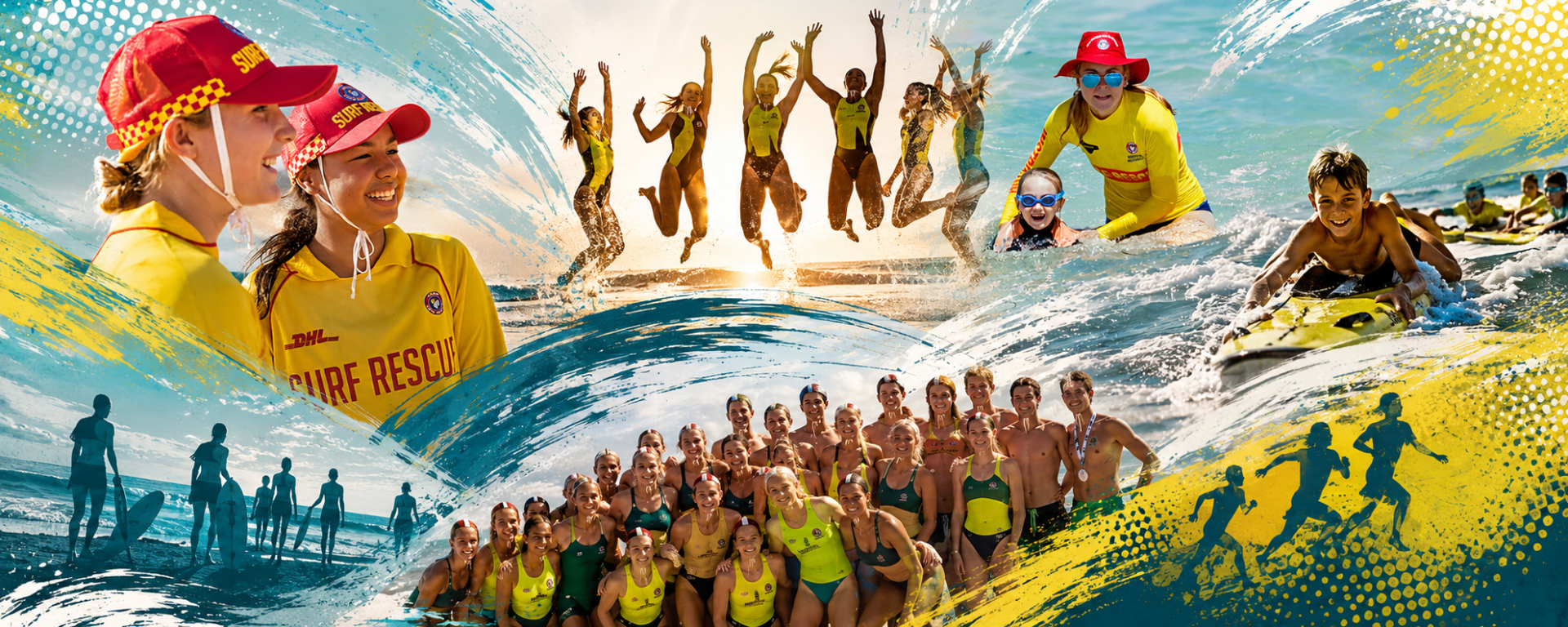
Welcome to another exciting season with Trigg Island SLSC's Youth program! Youth members are the lifeblood of the club — every time you dive into the surf, learn a new skill or make a new friend, you're building the future of surf lifesaving. Every contribution, from helping on the beach to lending a hand at events, adds to the strength of the club and the experiences it can offer.
Director of Youth: Kirk Phillips — youth@triggisland.com
2026–27 Youth Committee
Role | Name |
|---|---|
Director | Kirk Phillips |
Development Officer | Jenny Taylor |
Lead Activities Coordinator | TBA |
U14/U15 Activities Coordinator | James Noakes |
U17 Activities Coordinator | Kimba Herbert / Risma Price |
Lifesaving Coordinator | Kate Verkuylen |
Surf Sports Coordinator | Hayley Duguid |
Social Activities Coordinator | Cathy Reidy |
Youth Advisory Group Coordinator | Indiah Reidy |
4.2
Youth Sundays — Uniform & Equipment
Updated 15 Aug 2026 · Content
A typical Sunday
| Time | What's happening |
|---|---|
| 8:45am | Arrive for sign in |
| 9:00am | Club swim / warm up |
| 9:15am | Activities start |
| 10:30am | Activities finish / sign out |
| 10:30am onward | "The Break" — hangout in the new open space, with a draw card (fruit, popcorn and the like) |
Check the "What's Up!" noticeboard when you arrive — it shows what's on today for U14/U15s and U17s, what's coming up over the next few weeks, and what's happening around the Club (carnivals, Nippers, other events).
Surf Sports training doesn't run during Youth Club time — the two are kept separate this season so Sunday sessions stay focused on Youth Club activities.
What to bring
- Hi-vis vest (labelled)
- Bathers or wetsuit (if you get cold)
- Sunscreen (apply before arrival)
- Towel, hat and a long-sleeve shirt for after water activities
- Goggles, a labelled water bottle, and warm clothes for cooler mornings
Top tip
Write your name on everything — especially caps, vests and towels. Lost property builds up quickly, and unclaimed items are donated after two weeks.
Competition uniform
- Club cap (red/green/white) and club bathers
- Hi-vis vest compulsory for all aquatic activities
- Club apparel is available from the Merchandise Shop, outside the operations shed
Club equipment
Club boards and skis are for Youth members' use during designated activities only. Equipment must be returned, cleaned and stored correctly — report any damage to your coaches immediately.
4.3
This Season's Focus & Activities
Updated 15 Aug 2026 · Content
Trigg Island Youth's focus for 2026–27 is a "feet on the sand" approach — blending fun, fitness and lifesaving into every session, with activities for U14/U15s and U17s run separately and as one combined group.
This season's goals
- Build cohesiveness, camaraderie and connection — to the Club and to each other
- Improve retention and grow our numbers
- Build a culture that makes progressing from Nippers into Youth an easy, exciting step
- Make space for every interest across the Club, including Surf Sports
What you can expect on a Sunday
Sessions mix fun group activities with lifesaving skill-building — sometimes blended together, like practising board rescues and first aid alongside SRC and Bronze Medallion training. Expect a rotating mix through the season, such as:
- Beach games — giant dodgeball, tag games, a minefield blindfold challenge, frisbee competitions
- Water-based fun — board rescues, a try-a-ski day, bring-a-floatie day, pontoon relay, wet towel bucket relay
- Skills and awareness — mock first aid events, surf awareness signals and signs, IRB day
- Guest incursions — paramedics, lifeguards and Club leaders sharing what they do
- Bigger group days — body surfing competitions, team sandcastle competitions, bring-a-friend day
Keeping communication clear
The Club is streamlining Youth communications this season — including a separate channel for members focused on Surf Sports — so it's easier to see what's relevant to you.
4.4
Lifesaving Pathways
Updated 17 Aug 2026 · Grant
Youth members are eligible to complete their Surf Rescue Certificate and Bronze Medallion — the essential education and skills that lead to becoming a patrolling member. Courses run throughout the season, but we encourage eligible members to complete them as early as possible. Patrols are a voluntary weekend service, with a set number of hours required if you want to compete — see Patrols & Lifesaving and Awards & Training.
Surf Rescue Certificate (SRC) | Bronze Medallion | |
|---|---|---|
Minimum age | 13 | 15 |
Swim | 200m under 5 minutes | 400m under 9 minutes (pool) |
Run-Swim-Run | 100m / 100m / 100m under 5 minutes | 200m / 200m / 200m under 8 minutes |
Course | October course — 5 sessions plus assessment | 3 intakes: October, November/December, January |
Register | Via TeamApp | Via TeamApp | bronze@triggisland.com |
Check out all the awards available in Award Pathways Overview
4.5
Youth Pathways & Recognition Program
Updated 25 Sep 2026 · Grant
Surf Life Saving WA (SLSWA) runs a set of Youth Pathways for youth members from U14 to U17. They let you take on real roles around the club and across the state, and they formally record the service you give. There are three parts, and they all add up to the same record:
Youth Pathways courses: free SLSWA courses that train you for a role as an official, Age Manager, coach or trainer.
The Youth Recognition Program (YRP): the record of hours that earns you Bronze, Silver and Gold recognition.
State youth camps: four-day January camps in Margaret River for members nominated by their club.
You do not have to pick just one. Most youth members end up doing a bit of several: patrolling on a Sunday, helping an Age Manager with the Nippers, and officiating at a carnival later in the season.
Register your interest
Signing up for the YRP or any of the pathway roles starts with SLSWA's Youth Pathways Expression of Interest form, at the bottom of that page. See How to get started below for what you'll need.
Youth Pathways courses
SLSWA runs four free courses through the season, in person and online. Each one introduces a role you can then take on at the club, with an experienced member mentoring you. Hours you spend in these roles count towards your YRP record.
Course | What you learn and do | Register |
|---|---|---|
Youth Official | Every surf sports competition needs trained officials. You learn the basics of every officiating discipline, including timekeeper, marshal and check starter, so you can judge fairly and consistently. A good way into competition if you want a break from racing. | |
Youth Age Manager | The first step to becoming an Age Manager. You learn water safety for Nipper activities and events, then help mentor a group of Woodside Nippers on Sunday mornings, teaching beach safety and confidence in the ocean. | |
Youth Coach | Coach athletes at every level, mentored at club training. You build skills in the three surf sports disciplines (swim, beach and board) through practical assessment and online learning. | |
Youth Trainer | An introduction to SLSWA Training and Education, run by SLSWA accredited Trainers. You learn to deliver parts of courses and awards such as First Aid and the Surf Rescue Certificate, along with communication skills and how to work with parents and guardians. |
2026–27 course dates
Date | Course and time | Where |
|---|---|---|
Thu 27 Aug 2026 | Youth Age Manager, 5:30–7pm | Fremantle |
Fri 2 Oct 2026 | Youth Official, 9–11am | SLSWA |
Sat 17 Oct 2026 | Youth Coach and Youth Age Manager, 9–10am | Online |
Sat 14 Nov 2026 | Youth Coach and Youth Official, 8–11am (with the Fuel to Go & Play Surf Squad) | Floreat |
Fri 22 Jan 2027 | Youth Coach and Youth Official, 12–3pm (with the Fuel to Go & Play Surf Squad) | Bunbury |
Thu 28 Jan 2027 | Youth Coach and Youth Age Manager, 9–11am | SLSWA |
SLSWA may add dates during the season and announces them on its website, in eNewsletters and on social media. Download the 2026–27 Youth Pathways calendar, or see Youth Pathways Courses on the SLSWA site. To ask about other dates or locations, email youth@slswa.com.au.
Competing and patrolling count too
Surf Sports: board riding, swimming and beach sprints, from club events through to state, national and international competition. See Getting Into Competition to get started, and Competition Eligibility & Patrol Requirements for the patrol hours you need to compete.
Lifesaving: your Surf Rescue Certificate (from age 13) and Bronze Medallion (from age 15) are what let you patrol. Later they lead to specialist services such as drone patrol, lifeguarding and jet ski operations. SLSWA also runs the Rookie Lifeguard Program. Full course requirements are in 4.4 Lifesaving Pathways.
The Youth Recognition Program (YRP)
The Youth Recognition Program was previously called the Youth Leaders Program. It's how your involvement is formally recognised. Rather than a course you sit, it's a record you build: you log your hours across three parts of surf lifesaving (Lifesaving, Training and Surf Sports) and are recognised at each level you reach. A minimum in every part means the program rewards doing a bit of everything, not one thing over and over.
Level | Total hours | Minimum in each part |
|---|---|---|
Bronze | 60 | 4 hours |
Silver (after Bronze) | 80 | 6 hours |
Gold (after Bronze and Silver) | 90 | 8 hours |
Gold usually takes at least two years, so it's worth starting early. SLSWA has a separate recording sheet for each level.
Hours can be earned two ways:
At Trigg Island: patrolling, helping with Nippers, club officiating, training and competing.
Through SLSWA: the Youth Pathways courses above and the hours you then spend in those roles, plus the state camps.
Why it is worth doing
As well as the recognition itself, the YRP gives you a record of volunteer service and leadership experience. That's useful for job applications, university admission and scholarships.
State youth camps
Each January SLSWA runs two four-day camps at its South West Development Centre in Margaret River. They're a big part of the youth program: you meet members from clubs all over WA, build leadership and teamwork skills, and have a lot of fun. Up to two representatives from each WA club can go to each camp.
Camp | Who it's for | What it's about |
|---|---|---|
T.O.A.D. Camp | U14 and U15 | Teamwork, Opportunities and Development: a program that introduces a wide range of skills and activities, aimed at growing the next generation of surf lifesaving leaders. |
Rise Up Camp | U17 (15 and 16 year olds) | Physical and social activities that build personal leadership and resilience, and push you beyond your comfort zone. |
Places go by club nomination. SLSWA sends out the expression of interest in its Circular each July, and the club puts forward its representatives. If you'd like to be considered, tell the Youth Committee early: there are only two places per camp. More detail is on SLSWA's Youth Camps page.
Not the same as the club's Youth Camp
The state camps are separate from the club's own weekend Youth Camp, which is booked through TeamApp. See 4.7 Social, Camps & Events.
How to get started
Talk to the Youth Committee. They can help you choose the roles that suit you. You'll also need the club youth coordinator's details for the form.
Fill in the Youth Pathways Expression of Interest form on SLSWA's Youth Recognition Program page. Tick the Youth Recognition Program and any roles you're interested in (Youth Age Manager, Youth Coach, Youth Official, Youth Trainer). You'll need:
your name and current age group
your club: Trigg Island SLSC
the club youth coordinator's name, email and phone number
a parent or guardian's name and email
a mailing address
SLSWA emails you with what to do next.
Book a course from the dates above, and start logging your hours.
Questions for SLSWA go to the Youth team at youth@slswa.com.au.
Download the program brochure.
Download the SLSWA Youth Programs and Requirements for 2026/27 Circular.
To be confirmed
The Youth Committee can confirm who is currently the club's youth coordinator, and whether the club still has places to fill for the January 2027 camps.
4.6
Youth Awards & Recognition
Updated 15 Aug 2026 · Content
Surf Life Saving WA runs a Youth Leaders Program tracking positive involvement across Lifesaving, Surf Sports and Training, with three levels of achievement — Bronze, Silver and Gold — recognised from U14 through to U19. Taking part gives Youth members exposure to the different sides of surf lifesaving, recognition as a volunteer, and opportunities to attend camps run by Surf Life Saving Australia — all valuable for future employment or scholarship opportunities.
Club recognition awards
Each season, Trigg Island SLSC celebrates the hard work, dedication and achievements of its Youth members:
- U15 Lifesaver of the Year — outstanding patrolling service during the season
- Youth Club Achiever Award — outstanding contribution by a Youth Member (U14–U17) across Lifesaving, Training, Leadership and Surf Sports
- Youth of the Year — considered from among nominated Youth Club Achievers
- Youth Athlete of the Year — sporting excellence and contribution to Surf Sports, ages 15–18
- Youth Official of the Year — outstanding contribution to officiating during the season
- St Mary's Award — recognising a rising star in the Youth category
New for 2026–27
A new online recording and tracking app for the Youth Recognition Program is being piloted from early-to-mid season — details to follow from the Youth Committee.
4.7
Social, Camps & Events
Updated 15 Aug 2026 · Content
Regular events
- Volleyball Night — North Beach Volleyball Centre, 5pm–8pm, bar open for parents (subsidised by the Youth budget)
- Movie Nights — dates to be announced
- Around the Island Team Challenge — a club-wide team activity plus the Youth end-of-year BBQ
- BBQ Breakfasts — first Sunday of each month, after Youth sessions (helpers needed for setup, cooking and pack-down)
- Youth Camp — SLSWA South West Camp, Margaret River, a Friday-to-Sunday weekend of activities, teamwork and leadership (around $150pp including transport, accommodation, activities and main meals; $50 deposit required; essential registration via TeamApp)
⚠ To be confirmed
Several exact dates in the source material appear to be carried over from a previous season — check current dates for Volleyball Night, the Team Challenge and Youth Camp with the Youth Committee or via TeamApp before relying on them.
New for 2026–27
- Sunset Swim & Smoothie Day
- Ping Pong & Pizza
- Pancake Day
- Cook-off — groups take turns cooking up bacon-and-egg muffins, a sausage sizzle and more
Exact dates for these are shared via TeamApp and the "What's Up!" noticeboard as the season progresses.
4.8
Coaching, Training & Parent Involvement
Updated 15 Aug 2026 · Content
Training
As you grow, there are opportunities to take part in training sessions beyond Sunday Youth — designed to build skills, fitness and confidence in the water and on the beach. Because training times can shift with weather, coach availability or event scheduling, weekly updates are shared via TeamApp and WhatsApp — make sure you've joined your age group in the app. Surf Sports training is scheduled separately from Sunday Youth Club activities this season, so the two no longer overlap.
- Weekly schedules — released via TeamApp by Coach Andrew Mosel; 1–2 swim sessions a week are recommended
- Disciplines — boards, skis, boats, beach events, Rescue & Resuscitation, March Past, First Aid Competition, Champion Lifesaver
- Competition — carnivals at Metro, Country, State and Australian level; entry process, uniform requirements and team selection (participation vs high performance) are covered in Surf Sports & Competition
How parents can help
As a family club, Trigg relies on every family sharing the load. Ways to help on Sundays include kiosk duty, BBQs, event set-up and pack-down, and RSA bar service. There's also an Officials Pathway — an online plus practical course covering judging, marshalling and recording races at carnivals; contact the Club Administrator if you'd like to get involved.
5. Patrols & Lifesaving
5.1
Patrols Explained & Who Can Patrol
Updated 3 Oct 2026 · Grant
Patrolling is the core function of a surf life saving club. Every patrol hour served at Trigg Island Beach directly helps keep the community safe. The club holds a Patrol Contract with the City of Stirling that sets its patrol obligations and minimum service levels — the patrol season generally runs from October to the end of March, with exact dates confirmed each year by the Director of Lifesaving.
Requirements to patrol
Before you can patrol, you need to meet every one of these requirements:
Be a current financial member, registered in the SLS Members Hub
Hold a current SLSA award for your role (Surf Rescue Certificate for Cadets, Bronze Medallion for Active members)
Be proficient — annual Skills Maintenance completed by 31 December
Hold a current Working With Children Check where required
Be allocated to a patrol team by the Patrol Officer
No exceptions
A member who isn't financial, isn't proficient, or doesn't hold the right award for their role must not patrol. Patrolling without these in place breaches SLSA policy and may void your personal accident insurance.
Patrol requirements for Active Members and Cadets
Once you hold an eligible award — a Surf Rescue Certificate for Cadets, or a Bronze Medallion for Active members — you'll be allocated to a Club patrol team by the Patrol Officer.
You must complete the Club's full patrol roster for the season, unless you've been approved for an Individual Patrol Agreement (IPA) or hold an approved patrol exemption — see Individual Patrol Agreements & Exemptions
If you can't attend a rostered patrol, you must arrange a substitute holding an equivalent qualification, accepted through the SLS Members Hub — see Can't Make a Patrol?
If a patrol is missed, you must make up the hours by accepting another member's patrol swap request in the SLS Members Hub
Deficit
A member who does not attend a rostered patrol without an accepted substitute is considered in deficit and has not met their membership obligation — see Patrol Deficit & Consequences.
This still applies if you're on an IPA: your IPA sets an alternative schedule, but you remain responsible for arranging an accepted substitute for any individual absence within that schedule, and failing to meet your IPA commitments is treated as patrol default in the same way.
5.2
Patrol Roles & Award Requirements
Updated 15 Aug 2026 · Content
The award you hold determines the role you can perform on patrol. Each patrol is led by a Patrol Captain, supported by the team below.
| Role | Minimum award |
|---|---|
| Patrol Captain | Bronze + Silver Medallion Patrol Captain (18 years+) |
| Patrol Vice Captain | Bronze Medallion (Silver Medallion recommended) |
| Patrolling Lifesaver | Bronze Medallion |
| Patrolling Cadet | Surf Rescue Certificate (U13–U15), under supervision |
| Award Member | Relevant award, e.g. Radio, First Aid |
| IRB Driver | Silver Medallion IRB Driver + current driver's licence |
| IRB Crew | IRB Crew award + current proficient patrolling award |
| Observer | Observer Award — supervised, no independent duties |
Patrol Captain's authority
During patrol, the Patrol Captain has full operational authority over all members and activities in the patrolling area. Every member must follow the Patrol Captain's (or Vice Captain's) lawful and reasonable directions — this authority is non-negotiable during a patrol, and any disagreement or concern is raised afterwards through the appropriate channel, not on the spot.
5.3
The Roster, Sign On/Off & Your Hours
Updated 25 Sep 2026 · Grant
The patrol roster for the season is confirmed by 1 October and published in the SLS Members Hub, where you can also check your current patrol hours at any time:
Log in to the SLS Members Hub
Go to More > Patrols > Patrol Hours. You're responsible for knowing your patrol dates and committing to your schedule.
Your obligation
As an Active Member, your Club patrol obligation is to complete the Club's full patrol roster each season — either by personally attending every rostered patrol, or by arranging an accepted substitute through the SLS Members Hub for any you can't make (see Can't Make a Patrol?). An informal arrangement that isn't recorded in the Hub doesn't satisfy the obligation.
Membership category | Minimum patrol hours |
|---|---|
Active (15–18) and Active (18+) | Full patrol roster each season |
Active Reserve | As set by the Board each season |
Cadet (U14) | Minimum 16 hours, supervised |
Cadet (U15) | Full patrol roster |
Award Member | Full roster if assigned to a team |
Sign on and sign off
Signing on confirms who's on the beach, and it's the only way your hours are counted. Arrive ready for duty before the patrol starts (your Patrol Captain will confirm arrival times), sign on using the club's approved patrol recording system, check your equipment and radio with the Patrol Captain, and sign off before you leave at the end of your shift.
Always sign off
Patrol hours aren't counted unless you're correctly signed on and off — even if your replacement has already arrived. Running late? Let your Patrol Captain know as early as possible so coverage can be managed.
Patrol hours ≠ competition eligibility
Completing your Club roster — including via accepted substitutes — satisfies your Club membership obligation. It does not automatically satisfy SLSA's competition eligibility requirements, which are set independently and can't be waived by the Club. Patrols covered by a substitute count toward your Club obligation, but not toward your own personal patrol hours for competition — see Competition Eligibility & Patrol Requirements in Surf Sports & Competition.
5.4
Can't Make a Patrol?
Updated 25 Sep 2026 · Grant
Life happens — the key is to give as much notice as possible and arrange a substitute through the SLS Members Hub. When another qualified, proficient member accepts your swap, your obligation for that patrol is met and no make-up hours are needed. If no substitute is found, the missed patrol is recorded as a deficit (informally, you'd say you're "hours down").
Requesting a substitute
Log in to the SLS Members Hub at hub.sls.com.au
Go to More > Patrols > Upcoming Patrols to see your allocated patrols
Find the date you can't attend
Select "Request substitute" — the listing updates to show it as requesting a substitute
Raising the request in the Hub is the first step — for anything less than 48 hours' notice, also contact your Patrol Captain directly and, if it's urgent, other patrol members too (see the notification table below).
Accepting someone else's patrol
Log in to the SLS Members Hub
Go to More > Patrols > Patrol Substitutes Needed
Scroll to the list of patrols other members have flagged as needing a substitute
Find one you're eligible and available for, and select "I can do this"
Confirm when prompted — this accepts the substitution and updates both rosters
Exact wording may vary
These are the standard steps for the SLS Members Hub, the national platform every Surf Life Saving club uses — exact button wording can shift slightly with platform updates. If anything looks different, use the Hub's own help, or ask the Club Administrator.
Watch your competition hours
A substitute swap satisfies your Club obligation for that patrol, but it doesn't add to your own personal patrol hours. If you're aiming to compete at State or National Championship level, you need 16 personally-attended patrol hours from the calendar year prior — relying heavily on substitutes can leave your Club obligation met while you're still short for competition. See Competition Eligibility & Patrol Requirements in Surf Sports & Competition.
Notice given | What to do |
|---|---|
More than 48 hours before | Notify your Patrol Captain and raise a substitute request in the Hub immediately; monitor and follow up |
Less than 48 hours before | Notify your Patrol Captain immediately, raise the request in the Hub, and also contact other patrol members directly for urgent cover |
Emergency or same day | Call your Patrol Captain directly first, then raise the substitute request in the Hub as soon as practicable |
Making up hours
If you're hours down, you can make up the deficit by accepting a future-dated swap in the Hub (this restores your entitlements straight away), covering someone else's patrol as a substitute, or completing a patrol the Director of Lifesaving has marked as eligible for make-up.
5.5
Patrol Deficit & Consequences
Updated 15 Aug 2026 · Content
A patrol deficit builds up in two ways: hours deficit from partial absences (late arrival or early departure), or a missed patrol — a fully missed rostered patrol without an accepted substitute. Both are tracked, and consequences apply automatically unless you've accepted a patrol swap (including a future-dated one) or hold an approved exemption.
"Deficit" is the formal term used in Club policy — you'll commonly hear members call it being "hours down." They mean the same thing.
| Deficit level | Consequences |
|---|---|
| In deficit (any hours owed, or a missed patrol) | Not entitled to train using club facilities, compete, or use club-owned surf sports equipment or the gym |
| 8 deficit hours or 2 missed patrols | All the above, plus ineligible for club trophies, awards or incentives. Written notice from the Director of Lifesaving. |
| 12 deficit hours or 3 missed patrols | Membership may be suspended or terminated by the Board, with written notice and a right to respond first |
Entitlements are restored once you accept a patrol swap in the Hub, pending completion of that patrol. These are club consequences and sit alongside — not instead of — SLSA's separate competition eligibility rules; see Surf Sports & Competition.
5.6
Individual Patrol Agreements & Exemptions
Updated 15 Aug 2026 · Content
Individual Patrol Agreements (IPA)
An IPA is a formal, documented arrangement that changes how you meet your patrol obligation — not a reduction of it. You still serve the same total hours as other members of your category, just on a different schedule. IPAs may be available where you genuinely can't attend at least 50% of the standard roster due to FIFO or irregular work rosters, employment commitments outside your control, or other exceptional, ongoing circumstances approved by the Board. They're not available for lifestyle preferences, routine scheduling conflicts, members already in deficit, or short-term situations (use a patrol swap instead).
To apply, submit a written application to the Director of Lifesaving explaining your circumstances and proposed arrangement. If approved, the IPA is documented, signed by both parties, and reviewed at least annually — it doesn't automatically renew. If declined, you can request a review by the Board, whose determination is final.
Patrol exemptions
A patrol exemption is temporary or seasonal relief from patrol obligations, for situations that genuinely can't be managed through a patrol swap or an IPA — injury or illness, pregnancy, military or emergency service deployment, extended travel or work away from Perth, or other exceptional circumstances the Board approves.
A Club exemption applies only to Club membership obligations — it doesn't affect your separate obligations under SLSA Policy 5.04 for competition eligibility. Apply in writing to the Director of Lifesaving before the season starts, or as soon as practicable after an unexpected event.
5.7
Fitness for Duty & Conduct on Patrol
Updated 15 Aug 2026 · Content
Fitness for duty
You must present for patrol ready and capable of performing your assigned duties. You must not patrol if you're under the influence of alcohol or any impairing substance, suffering an injury or illness that prevents you safely performing your duties, or in a state that impairs your judgement or ability to respond to an emergency. If you're unwell, injured or otherwise unfit, notify your Patrol Captain as early as possible so cover can be arranged.
Where illness or injury strikes with no reasonable opportunity to arrange a substitute, your Patrol Captain can excuse you from that patrol — it won't count as a deficit. If you're likely to be unable to patrol for an extended period, consider applying for a patrol exemption.
Conduct on patrol
- Follow the SLSA Code of Conduct and the club's Membership Policy at all times
- Be professional and courteous with the public, fellow patrol members, and other services (City of Stirling Lifeguards, WA Police, the Surf Rescue Helicopter crew)
- Don't use your personal phone for non-emergency purposes during active patrol hours, unless the Patrol Captain authorises it
- Stay vigilant and alert — patrolling requires sustained attention and readiness to respond
- Don't consume alcohol or any impairing substance during patrol hours or in the patrol area
Conduct that puts the public, fellow members, or the club's reputation at risk is taken seriously — see Patrol Deficit & Consequences and Complaints, Grievances & Discipline.
5.8
Incident Reporting & Equipment
Updated 24 Sep 2026 · Grant
All incidents — rescues, first aid treatments, preventive actions, near-misses and injuries to members or the public — must be reported through the SLSA incident reporting system, ideally before or immediately after sign-off. Accurate, timely reporting creates an official record of the club's service, supports insurance requirements, and is a requirement of the Patrol Contract with the City of Stirling.
Critical incidents
If an incident meets the definition of a Critical Incident — a fatality, serious injury, significant near-miss, or anything likely to cause significant distress — it triggers the Club's Critical Incident process straight away. See Critical Incidents & Support.
Equipment
Use equipment only for its intended purpose and in line with SLSA training and club procedures. Report any damage, loss or malfunction to the Patrol Captain immediately, return everything to its correct storage location in serviceable condition at the end of each patrol, and don't use or modify club equipment without the Patrol Captain's authority. Vehicle operators (ATV/SSV, IRB) must hold the relevant SLSA award and a current driver's licence for land vehicles.
5.8.1
Radios
Updated 23 Sep 2026 · Grant
Trigg's patrol radios are Icom handhelds that work on two networks at once: the Telstra mobile network for the Metro channels, and VHF for line-of-sight channels. The radio carries two channels at the same time, one on each transmit button. A radio induction is required before you patrol.
Which channel to use
Broadcast all patrol operations on Metro Wide so Surfcom monitors and records them. Use VHF or your club channel for admin, training and other non-patrol traffic. Formal radio protocols apply on every channel, every time.
Start up
Take the radio off the charger.
Turn on with the On/Off/Volume knob and set the volume.
Wait while it connects to the Telstra network — up to 40 seconds.
Check the two channels shown, then hold CLR to lock the keypad.
How to transmit
The display shows two channels. The top line is the channel on the top (large) PTT, and the lower line is the channel on the bottom (small) PTT. To swap them, press and hold FUNC.
Button | Channel | What it is |
|---|---|---|
Top PTT — large | Metro Wide | Telstra network. Surfcom monitors this channel. Listen before you speak; a beep confirms the channel. |
Bottom PTT — small | VHF1 – Ops | VHF, line of sight only. Use for club communication. Neighbouring clubs may be heard. |
On patrol
Keep Metro Wide as the top channel, on the large PTT.
Listen before speaking — several members can talk on the Telstra channels at once.
Use “Over” or “Out” so others know when the channel is clear, and keep to standard pro-words.
Surfcom monitors only the Area Wide channels day to day, and may move the club to another channel during a major incident.
VHF Marine channels
Only use the VHF Marine channels when directed to by Police, Marine Rescue or Surfcom. Improper use may result in fines.
Metro channels
Channel | What it is |
|---|---|
1 | Metro Wide — Surfcom monitored |
2 | Metro Ops |
3 | Metro ERT |
19 | Trigg Island — club channel |
01–05 | VHF Ops — line of sight |
06–18 | VHF Marine — when directed |
The controls
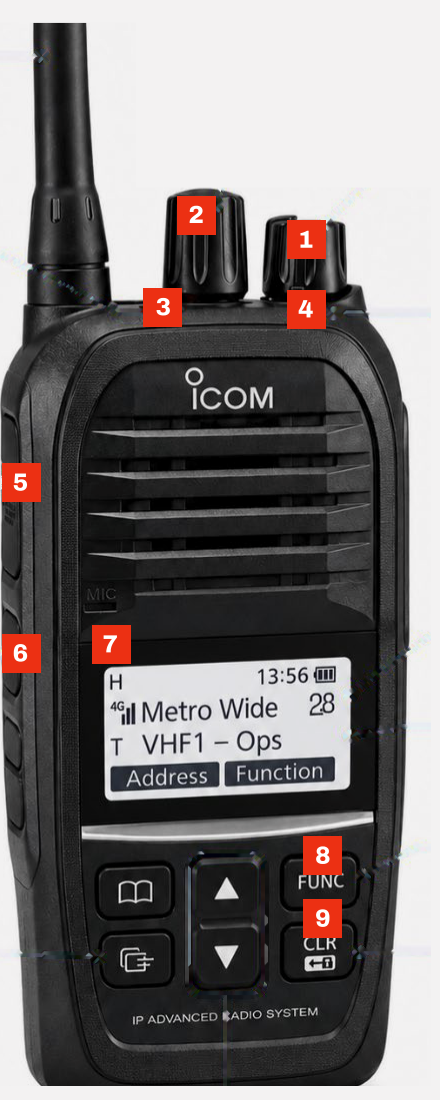
# | Control | What it does |
|---|---|---|
1 | On/Off/Volume | Turn on, set volume |
2 | Channel Selector | Changes the top channel |
3 | Emergency Distress | Distress button |
4 | Indicator | Red transmitting, green receiving |
5 | Top PTT (large) | Transmits on the top channel |
6 | Bottom PTT (small) | Transmits on the lower channel |
7 | Display | The two channels you are on |
8 | FUNC | Press and hold to swap the two channels |
9 | CLR | Press and hold to lock / unlock the keypad |
When you finish
Turn the radio off, make sure it is dry, and put it back on the charger.
Where this comes from
SLSWA Icom Radio Guide v1.1. A radio induction is required before patrolling — ask your Patrol Captain if you have not done one.
5.8.2
Public Warning System
Updated 23 Sep 2026 · Grant
Trigg Beach has a siren system for warning the public — to clear the water, to call every available lifesaver, and to signal that the water is open again. It belongs to the City of Stirling and covers three zones: North, Middle and South. Most of the decisions below belong to the Duty Patrol Captain, but everyone on patrol should know what the signals mean and what happens afterwards.
What the signals mean
Signal | What it means |
|---|---|
Continuous tone | Evacuation — get the public out of the water |
Three short blasts | Lifesaver alert — all available lifesavers respond |
One short blast | The water is open again |
Who can sound it
City of Stirling Beach Inspectors activate the siren remotely, and are the only ones who can sound a single zone.
The override switch in the patrol tower sounds all three zones at once. Tower observers use it, and only on the authority of the Duty Patrol Captain.
How to sound it
The normal way is to ask the Duty Beach Inspector over the radio and let them activate it.
Use the override when the Beach Inspector cannot be reached, or when waiting for them would put someone at risk. The Patrol Captain authorises it, and says why over the SLSWA radio network as it happens.
Before you reach for the switch
The siren is heard by the whole beach and everyone near it. Sounding it when it is not needed causes alarm and costs the club public trust. Every activation is a decision the Patrol Captain owns and has to be able to explain afterwards.
When to sound it
Situation | What to do | Signal |
|---|---|---|
Confirmed shark sighting | Ask the Duty Beach Inspector. Override if they are uncontactable, or the delay is unreasonable. | Continuous tone |
Shark attack, major emergency, or anything needing the water cleared | Ask the Duty Beach Inspector. Override straight away if there is immediate danger to life. | Continuous tone |
Mass rescue — calling in every available lifesaver | Ask the Duty Beach Inspector. Override if contacting them is delayed or impractical. | Three short blasts |
Reopening the water once the area is safe | Ask the Duty Beach Inspector. Override if they are unavailable. | One short blast |
Say it on the radio
Every activation — whether you asked for it or used the override — goes over the SLSWA radio network, with the reason. That is what creates the recorded account of the decision. Keep it short and specific:
For example
“Trigg Patrol Captain authorising full siren activation due to confirmed shark sighting — Duty Beach Inspector uncontactable.”
After the siren
If you used the override, tell the Duty Beach Inspector as soon as you practically can.
Write it in the patrol log: the time, the reason, whether it was requested or overridden, who authorised it, and that the Beach Inspector was notified.
Report the activation to the Patrol Officer, or the relevant City of Stirling contact, if that is required.
If it is not clear cut
Two situations come up often: the Beach Inspector is contactable but their response time might create risk, and a shark sighting that is not fully confirmed. There is no rule that settles these — the Patrol Captain decides, and the call is theirs.
Put public safety first, say what you are doing and why over the radio, and write it down. A decision that is explained and recorded holds up; a silent one does not.
5.9
Water Safety
Updated 15 Aug 2026 · Content
No Club activity in or near the water — Nippers, training, Surf Sports, even patrol support activities — can go ahead without water safety in place. It's a core part of how Trigg Island SLSC keeps everyone safe, and it relies entirely on volunteers.
No water safety, no activity
If an activity doesn't have adequate water safety cover, it cannot proceed. This applies right across the Club — Nippers sessions, Youth and Surf Sports training, and other aquatic activities all depend on it.
We're always looking for volunteers
Water safety depends on members stepping up — the Club is always looking for more volunteers to help. If you hold a Surf Rescue Certificate or Bronze Medallion, you're qualified to help provide water safety for training and other activities, beyond your own patrol commitments.
Volunteering via PatrolMate
Trigg Island SLSC uses PatrolMate, an online app, for members to volunteer for water safety and other Club helper roles. It's the easiest way to see what help is needed and put your hand up.
The basics of how water safety works
Water safety at Trigg Island follows the SLSA Water Safety Procedure (Policy 1.01A). The full detail is technical, but the general principles are:
- Every activity has a Water Safety Supervisor — a Bronze Medallion holder who leads the water safety team, assesses the risk before and during the activity, and stays on the beach coordinating the response
- They're supported by Water Safety Personnel — members holding a Surf Rescue Certificate or Bronze Medallion, positioned on the beach or in the water as directed
- Before an activity starts, the Water Safety Supervisor completes a risk assessment and puts together a water safety plan — covering conditions, numbers, the team, and what to do in an emergency
- Minimum supervision ratios apply, based on conditions and how experienced the participants are — riskier conditions or larger groups need more water safety cover, and some conditions mean an activity simply can't go ahead
- Everyone providing water safety wears identifiable high-vis gear, and rescue equipment must be on hand and ready to use
Full detail
This page covers the general principles only. The complete SLSA Water Safety Procedure — including exact supervision ratios and equipment requirements — is available from the Director of Lifesaving or the SLS Hub Document Library.
Getting involved
If you'd like to help with water safety — for Nippers, Youth, Surf Sports training or otherwise — register your interest via PatrolMate, or speak to the Director of Lifesaving.
6. Surf Sports & Competition
6.1
Getting Into Competition
Updated 15 Aug 2026 · Content
From club events through to state and national championships, surf sports at Trigg Island SLSC are open to members of all abilities. The Surf Sports Committee plans the season program and coordinates club entries, and coaches support members across board, ski, swim, beach and IRB events, plus traditional events like boats, IRB and March Past.
Governance
The Surf Sports Committee — chaired by the Director of Surf Sports — plans the intraclub calendar, coordinates entries to SLSWA, Branch and SLSA events, and advises the Board on competition policy, team selection and representative events. The Board of Directors retains ultimate authority over eligibility determinations, disciplinary matters and selection disputes, and may delegate specific authority to the Committee by resolution.
Training
The surf sports training program is released on Team App each Monday for the week ahead, covering board, ski, iron and beach sessions. All Trigg members must wear high-vis for water-based sessions.
6.2
Ocean Events
Updated 16 Aug 2026 · Content
Ocean events are the heart of surf sports — testing swimming, paddling and boat skills out in the surf itself.
- Surf Swim — endurance, speed and surf awareness; individual and team races swimming around buoys and back to shore
- Board Paddling — strength, balance and surf skill on a racing board; individual races, board rescue (swimmer plus paddler), and three-person relay teams
- Surf Ski Racing — power, endurance and ocean knowledge; individual, double and relay ski formats
- Ironperson — a multi-discipline race combining swim, board paddle, ski paddle and beach run in one continuous course
- Surf Belt Race — a traditional event where a belt swimmer, linesmen and reel handler work together: the swimmer races to a buoy and is hauled back in
- Rescue Tube/Board Rescue — simulated rescue scenarios testing lifesaving skill, speed and technique, using swimming or paddling
- Taplin Relays — team relays combining swim, board, ski and run legs (the Youth "Cameron" version drops the ski leg, using swim, board and run only)
- Board Riding — surfing judged on wave selection, length of ride, and the quality and difficulty of turns and manoeuvres
Surf Boats also race in the ocean — see Surf Boat Racing.
6.3
Beach Events
Updated 16 Aug 2026 · Content
- Beach Runs — 1km and 2km races, individual or team, run on sand
- Beach Sprints & Flags — 70–90m sprint races, individually or in relay teams; flags is an elimination event starting from a prone position
- March Past — a ceremonial parade in club uniform carrying the surf reel, judged on timing and formation
6.4
Lifesaving Events
Updated 16 Aug 2026 · Content
- Champion First Aid — a team event testing CPR, spinal management, bandaging and patient assessment
- Champion Lifesaver — an individual event combining surf swimming, board paddling, beach running, CPR and first aid
- Champion Patrol — a team event simulating real beach patrol duties: rescue scenarios, first aid, patient assessment and equipment use
- Rescue & Resuscitation (R&R) — teams of 2–6 perform a simulated rescue and resuscitation under strict procedure, judged on accuracy and timing
6.5
Surf Boat Racing
Updated 16 Aug 2026
A surf boat crew is four rowers and a sweep. Crews row out around their assigned turning buoy and back to the beach, across men's, women's and mixed divisions — teamwork and skill count as much as raw power.
6.6
IRB Racing
Updated 16 Aug 2026
A high-speed team event simulating a rescue using an Inflatable Rescue Boat (IRB), crewed by a driver and crewperson who navigate the surf, "retrieve" a patient, and return to shore. Four event types — IRB Rescue, Mass Rescue, Tube Rescue and Teams Rescue — all test speed, coordination and surf knowledge.
IRB Racing and Pool Rescue are typically contested outside the main patrol season, as part of SLSA's Winter Events calendar.
6.7
Pool Rescue
Updated 16 Aug 2026 · Content
Pool rescue events test lifesaving skills in a controlled swimming pool environment, using manikins, rescue tubes and fins to simulate rescues — combining swimming speed with accurate rescue technique. Events include manikin carry, obstacle swim, and simulated victim rescue relays, run individually or in teams.
6.8
Captains & Coaches
Updated 15 Aug 2026 · Content
| Captain | Name |
|---|---|
| Beach Captain | TBC |
| Ski Captain | TBC |
| Board Captain | TBC |
| Swim Captain | TBC |
| Boat Captain | TBC |
| Masters Captain | TBC |
| Coach | Name |
|---|---|
| Head Coach | Andrew Mosel |
| Board Coach | TBC |
| Ski Coach | TBC |
| Beach Coach | TBC |
⚠ To be confirmed
Most Captain and Coach names weren't supplied in the source material — Head Coach Andrew Mosel is the only confirmed contact. Check with the Surf Sports Committee for the current team leads.
Board and ski rack allocations
Members who regularly train and compete for the club may apply for a designated rack in the club shed for an annual fee — $95 for a ski rack, $75 for a board rack. Applications open at the start of each season, with allocations finalised soon after. Equipment stored at the club isn't covered under SLSA or club insurance.
6.9
Competition Eligibility & Patrol Requirements
Updated 17 Aug 2026 · Grant
Before representing Trigg Island SLSC in any event — intraclub, interclub or championship — you must:
Be a current financial member, registered in the SLS Members Hub
Hold the appropriate SLSA award for the age category and event
Be currently proficient — annual Skills Maintenance completed
Have met your patrol and service commitments
Not be in default of any club, Branch, State or SLSA obligation — financial, service or disciplinary
Meet any event-specific requirements, such as an IRB Driver licence or Surf Boat sweep accreditation
New members — the 120-Day Rule
Non-award members aged U15 and above who are new to SLSA may compete in non-championship competitions for up to 120 days from joining, provided they complete a basic assessment, have appropriate coaching supervision, and the club provides adequate water safety. Approval from the Director of Surf Sports is needed before entering events under this rule.
⚠ To be confirmed
The exact patrol-hours rule for members joining from 1 January onward hasn't been finalised in the source material — check with the Director of Surf Sports before relying on a specific figure.
Junior (Nipper) eligibility
Only U8–U13 Nippers are eligible to compete (U6 and U7 take part in the program but don't compete), and only once they've met the Preliminary and competition evaluation swim criteria assessed by their Age Manager — see Nipper Competitions.
Patrol and service obligations
Active, Cadet, Active Reserve and Award members must be meeting their Club patrol obligations to be eligible for interclub and championship events — see Patrols & Lifesaving. Club obligations and SLSA competition eligibility are separate and distinct: completing your Club roster — including via accepted substitutes — satisfies your Club obligation, but doesn't automatically satisfy SLSA's competition eligibility requirements, which the Club cannot waive.
State & National Championship patrol hours
To be eligible to compete at State or National Championship level, you must personally complete at least 16 patrol hours during the calendar year prior to the season you're competing in, in addition to meeting your Club patrol requirement. These must be hours you personally attended — patrols covered by a substitute count toward your Club obligation, but not toward this personal total. Relying heavily on substitutes to manage your Club roster can leave that obligation met while you're still short for State/National eligibility, so plan ahead if you're aiming to compete at that level.
Members on approved leave aren't automatically ineligible; the Board considers each case, and may grant an exemption in exceptional circumstances — though a Club exemption doesn't affect your separate SLSA competition eligibility obligations.
6.10
Competition Uniform
Updated 15 Aug 2026 · Content
Mandatory at interclub & championship events
Members representing Trigg Island SLSC must wear an approved competition bather — the club's registered design, or plain black if you don't yet have one — and the club's registered competition cap. No other swimwear is permitted without written Board approval.
| Uniform item | Intraclub | Interclub / Championship |
|---|---|---|
| Club competition bather | Encouraged | Mandatory |
| Plain black swimwear | Permitted | Permitted as the only alternative |
| Board-approved special bather | As approved | Requires Board approval |
| Club competition cap | Encouraged | Mandatory |
| Helmet (craft events) | As required by event rules | As required by event rules |
| High-visibility vest | As prescribed | As prescribed |
Helmets
SLSA-certified surf helmets are compulsory for boat rowers and sweeps, and for IRB Patients (except the IRB Rescue Tube Race). Helmets worn in competition must display the club's cap colours, or be covered to match.
A competitor not properly dressed can be excluded by the Referee at an SLSA-sanctioned event, or directed by the Director of Surf Sports to change before competing at a club event. Uniform items are available from the Club Administrator — the club may also provide bathers or caps to members facing genuine financial hardship, on confidential application.
6.11
Intraclub Competition & Club Championships
Updated 15 Aug 2026 · Content
Intraclub competition gives every member the chance to compete in a supportive, club-based environment that builds participation, skill and enjoyment — an important stepping stone before interclub and championship competition. The Surf Sports Committee sets the season's Club Championship program (potentially covering ocean swimming, board paddling, beach sprints and relays, IRB, Junior and Masters events) ahead of the season, with reasonable notice of any changes.
Categories
| Senior | Masters | Junior |
|---|---|---|
| Open, U19, U17, U15, U14 (Male & Female) | Masters 30–49, Super Masters 50+ (Male & Female) | U8, U9, U10, U11, U12, U13 |
A Club Championship event needs at least 3 eligible entrants in a category to run — with fewer, the Committee may combine categories or cancel that event for the season. To be eligible for a Club Championship swimming trophy, you need at least 3 qualifying training swims or intraclub events beforehand.
Intraclub eligibility
To take part in intraclub events, you need to be a current financial member, hold a current SLSA award appropriate to the event (or be an eligible Junior member), and hold current Skills Maintenance proficiency where required. The strict interclub patrol requirements don't automatically apply — though members significantly non-compliant with patrol obligations may still be deemed ineligible by the Committee.
6.12
Interclub, Championship & Masters Competition
Updated 15 Aug 2026 · Content
Competing at an interclub or championship event as a member of Trigg Island SLSC is a privilege — you're an ambassador for the club and for surf lifesaving, on and off the competition course.
Entering an event
- Notify the Director of Surf Sports or Surf Sports Committee before the entry deadline (for Nipper events, notify your Age Manager)
- Confirm your eligibility — see Competition Eligibility & Patrol Requirements
- Pay any applicable entry fees by the nominated deadline
- Confirm your availability for the scheduled day(s)
Late entries are subject to approval by the Director of Surf Sports and depend on whether the event organiser accepts them — the club can't be responsible for a missed deadline. Members are generally responsible for their own entry fees for individual events; for team events, the Committee advises the fee-sharing arrangement.
Team selection
Where the club enters team events — beach relays, Champion Lifesaver, IRB teams, surf boat crews, March Past — selection is the Surf Sports Committee's responsibility, in consultation with coaches, based on demonstrated ability and performance, availability, compliance with patrol and membership obligations, and conduct consistent with the club's values. The Committee's decisions are final; raise a concern with the Director of Surf Sports first, then the Board if unresolved.
Masters
Masters competitors 30 years and above compete in 5-year age groups across beach, surf, boats and rescue. Key 2026–27 dates include the SLSWA Masters State Championships (13–14 February 2027, Perth) and the Australian Masters Championships (Sunshine Coast, Queensland).
⚠ To be confirmed
The exact national Masters Championship dates and the full 2026–27 club and SLSWA carnival calendar weren't supplied in the source material — check the SLSWA MyBeach website for the current list.
Trigg has one of the largest Masters contingents in Western Australia, with dedicated training sessions on the weekly schedule — all Masters are welcome at Trigg's surf sports training and the club's carnivals.
6.13
Conduct, Protests & Disputes
Updated 15 Aug 2026 · Content
Standards expected of competitors
- Compete with integrity, sportsmanship and respect for fellow competitors, officials and the competition environment
- Accept officials' and referees' decisions without argument — disputes go through the formal protest process
- Support and encourage fellow Club members and competitors from other clubs
- Avoid any conduct that could bring the club, SLSWA or SLSA into disrepute
- Follow directions from coaches, team managers, officials and event organisers
- Behave appropriately on social media in relation to competition activities and results
Conduct breaches
Unsportsmanlike behaviour, safety rule breaches, ignoring officials' directions, or bringing the club into disrepute can mean exclusion or disqualification from an event, referral to the Surf Sports Committee or Board, suspension from further competition, or referral to SLSWA/SLSA for disciplinary action. See Complaints, Grievances & Discipline for how disciplinary matters are handled at club level.
Protests and disputes
Protests about decisions at an SLSA-sanctioned event follow the process and time limits set out in the SLSA Surf Sports Manual and communicated by officials at each event. Intraclub disputes about eligibility, results or conduct go to the Director of Surf Sports first, then the Surf Sports Committee and, if necessary, the Board — whose determination is final. Eligibility disputes at any level are referred to the Board, and a member may be permitted to compete provisionally while a determination is pending.
6.14
Personal Use Allocation of Club Craft
Updated 15 Aug 2026 · Content
The Club maintains a register of competition craft — including named boards and skis such as the Avenell Family Board and the Rotary Club Ski — for exclusive personal use by eligible youth members. This program supports young athletes who'd benefit from dedicated access to Club-owned competition craft for training and competition.
The Director of Surf Sports keeps a current Schedule of Club Craft Available for Allocation, listing exactly which craft the Board has approved for this program. As a general guide, boards are available to U14–U15 members (and may extend to U17 where a two-season allocation crosses age groups), and skis to U17 members (extending to U19 in the same way).
Eligibility
In addition to the Club's general competition eligibility requirements (see Competition Eligibility & Patrol Requirements), to apply you must:
- Be an Under 14, 15 or 17 member of Trigg Island SLSC
- Have been a Club member for at least two seasons, including Nipper seasons
- Have regularly attended WA Surf Sport carnivals and the WA State Championships in the previous and current season
- Have your Club coach attest to your dedication to training
- Not already hold another current personal use allocation — preference goes to members who don't already have allocated equipment
Applications are assessed by the Surf Sports Committee (the Director of Surf Sports and Director of Youth), whose decision is final. An allocation runs for two seasons from the date of approval.
What's expected of you while you hold an allocation
- Attend coaching sessions for the relevant discipline regularly throughout the season
- Attend selected surf sport events during the season, including the WA State Surf Life Saving Championships
- Use the craft only for your own training and competition — it can never be transferred to another member or person
- Take responsibility for the craft and its repair while it's allocated to you — any damage or repairs needed when it's returned will be charged to you
- Return the craft to the Club in good working order at the end of the allocation period
- Tell the Director of Surf Sports promptly about any injury, your expected recovery timeline, and stay in touch during any period you're not training
- Let the Director of Surf Sports know about any planned extended absences during the season
It's always the Club's craft
Allocated craft remains Trigg Island SLSC's property at all times — you can't sell, transfer or dispose of it under any circumstances. Not meeting the requirements above can result in the Board cancelling your allocation.
How to apply
Complete the Club's Equipment Allocation Application Form — available from the Club Administrator or the document system — and submit it to the Director of Surf Sports. Applications are assessed at the start of each season.
6.15
Storage of Personal Craft
Updated 24 Aug 2026 · Grant
Subject to available space, the Club can offer eligible members somewhere to store their own privately-owned surf sports craft at Club facilities, to support training. Storage is limited to competition boards, skis and — space permitting — competition surfboards. No other personal equipment can be stored on Club premises.
Store at your own risk
The Club takes no responsibility for loss or damage to personal equipment stored on-site, and does not insure it. You store your craft entirely at your own risk.
Eligibility
In addition to the Club's general competition eligibility requirements (see Competition Eligibility & Patrol Requirements), you need approval from the Director of Surf Sports to store craft at the Club.
Storage fees
The Board sets storage fees at the start of each season, published on the Club's fee schedule. Fees are paid through the Club's payment gateway at the time of application. If your application isn't granted, your fee is refunded in full.
Current fees aren't listed here since the Board reviews and sets them annually — check with the Club Administrator or the document system for this season's rate.
If demand exceeds space
When there's more demand than available storage, the Director of Surf Sports allocates spaces in this priority order:
Priority | Category |
|---|---|
1 | Open athletes competing at more than half of carnivals and training regularly |
2 | Coaches running regular training sessions for Club members in their discipline |
3 | Age group athletes (U14, U15, U17, U19) competing at more than half of carnivals and training regularly |
4 | Masters athletes competing and training regularly |
Conditions of storage
Storage is granted for the current season only — you'll need to reapply each season
You can only use the specific rack or space the Director of Surf Sports allocates to you
Craft must be kept in the allocated area within the operations shed, or wherever else the Director of Surf Sports designates
If your patrol obligations lapse during the season, the Director of Surf Sports may issue you a written warning — if it's still not resolved after that, your craft must be removed from Club premises within 7 days
The Club can ask you to remove your craft at any time — you'll have 7 days to do so
How to apply
Complete the Club's Craft Storage Application Form. Applications are assessed on a rolling basis, subject to available space.
7. Awards & Training
7.1
Award Pathways Overview
Updated 16 Aug 2026 · Grant
SLSA's award pathway lets you build your lifesaving knowledge and skill step by step — every award is nationally recognised and transfers between clubs anywhere in Australia.
Junior development (Nippers)
Surf Education Certificates (U6–U13) build progressive surf awareness and safety knowledge. Adults aged 18+ can complete the Nipper Rescue Certificate to provide water safety alongside qualified SRC and Bronze Medallion holders.
Member courses
These are the courses available to members in WA, with what you need before you start, the minimum age, and how often the award must be renewed.
Award | Prerequisites | Min. age | Renewal |
|---|---|---|---|
WA Nipper Rescue Certificate (NRC) | 200 m swim in 6 min | 18 | Yearly |
Surf Rescue Certificate (SRC) | 200 m swim in 5 min | 13 | Yearly |
Bronze Medallion (BM) | 400 m swim in 9 min | 15 | Yearly |
Radio Operator (RO) | — | 13 | Yearly |
Resuscitation Certificate | — | 10 | Yearly |
First Aid | — | 14 | 3 years |
Advanced Resuscitation Technique (ART) | First Aid | 15 | Yearly |
Pain Management (PM) | Bronze Medallion, ART, First Aid | 18 | 2 years |
Silver Medallion Aquatic Rescue (SMAR) | Bronze Medallion, 400 m swim in 8 min | 16 | Yearly |
Silver Medallion Patrol Captain (SMPC) | Bronze Medallion | 17 | Varies |
Gold Medallion (GM) | Bronze Medallion, SMPC, First Aid, ART, 800 m swim in 14 min | 17 | Yearly |
IRB Crew (IRBC) | Bronze Medallion | 15 | Yearly |
Silver Medallion IRB Driver (IRBD) | Bronze Medallion, IRB Crew, RST | 17 | Yearly |
Rescue Water Craft Operator (RWC) | Bronze Medallion, RST, driver's licence | 18 | Yearly |
SSV Induction | Driver's licence | 17 | None |
WA Training Officer (TO) | — | 16 | 2 years |
WA Assessor (A/C) | WA Training Officer, plus trained two full courses | 18 | 2 years |
RST is the Recreational Skippers Ticket. Renewal means an annual Skills Maintenance Check for most awards — see 7.2 Annual Skills Maintenance. First Aid, ART and the Resuscitation Certificate are also nationally accredited units (HLTAID011, HLTAID015 and HLTAID009), delivered by SLSWA or by a club holding an auspice agreement.
Other awards you may hear about
The Observer Award, UAV (Drone) Patrol Operator and Rock, Rescue and Retrieval are SLSA awards that are not on the SLSWA member course list above, so their prerequisites and renewal cycles are not published there. Ask the Director of Education if you are interested in any of them.
Coaching, officiating & leadership
Age Manager Award (renews every 5 years, current WWCC required), SLSA Surf Sports Coach and SLSA Official. Trainer, Assessor and Facilitator roles — the members who deliver and assess these courses — have their own pathway and currency rules, set out in 7.4 Training & Assessing.
When is the next course?
Club courses are added to the Club Calendar as they are scheduled, so check there first. If the course you are after is not listed yet, contact the Education team — the club has a separate contact for each award area, listed in 1.3 Getting Involved & Key Contacts. They can tell you when the next intake is planned and note your interest.
7.2
Annual Skills Maintenance
Updated 27 Aug 2026 · Grant
31 December deadline
Every patrolling member must complete their annual Skills Maintenance by 31 December each season. Miss it, and you can't patrol, operate rescue craft, or compete until you're proficient again — this is a national SLSA rule, not a club discretion.
Skills Maintenance (also called "proficiency" or "requal") is a targeted annual check-in, not a full re-exam — it typically has two parts: online theory via the SLS Members Hub eLearning platform, completed before you attend, and a practical assessment at the club with a qualified Assessor, covering rescue scenarios, resuscitation, signals and award-specific skills.
Each skill only needs to be demonstrated once per season, even if it counts toward more than one award you hold — and a fitness test completed for a higher award (like Gold Medallion) satisfies the fitness requirement for lower prerequisite awards too.
How to book a face-to-face session
Log in to the SLS Members Hub at hub.sls.com.au
Go to Application > eLearning in the top menu
Click the red "Login to eLearning" button
Select "Training Event" from the left menu and browse the calendar for an available session
Select your session and click "Enrol"
Pre-enrol before you attend
If you're unable to register online, contact proficiency@triggisland.com before attending — the Education team may not be able to accommodate arrivals on the day who haven't pre-registered.
If your award has lapsed
Less than one full season — you can generally complete the current season's Skills Maintenance to regain proficiency, subject to Assessor sign-off
More than one year — a qualified Assessor completes a gap analysis, and you may need extra training in identified gaps before being reassessed
Five or more years — the general guideline is to complete the full award assessment again, though exceptions can be made where you can demonstrate the right skill set through experience or other qualifications
Contact the Director of Education first if your award has lapsed, to talk through the right pathway back.
2026/27 Skills Maintenance Requirements
Click here to view the SLSWA 2026/27 Season Skills Maintenance requirements.
7.2.1
Online Modules
Updated 17 Aug 2026 · Grant
Completing Your Online Skills Maintenance Modules
All patrolling members must complete an annual skills maintenance check (proficiency) for each award they hold and wish to keep current. Skills maintenance has two parts: an online theory component and an in-person practical check. The online theory must be completed before you attend your practical session.
This section explains how to access the SLS Hub, open the eLearning platform, and complete your online modules.
Before You Start
You will need:
A current, financial membership with the club for this season. Your access will not work if your membership is still pending or unpaid.
An SLS Hub account. If you do not have one, go to hub.sls.com.au and select Sign Up.
Access to the email address recorded against your membership, for account verification.
Step 1: Log In to the SLS Hub
Go to hub.sls.com.au.
Sign in using your existing Members Area username and password.
The first time you log in, you will be prompted to reset your password and verify your account by email. Two factor verification may be requested for the first few logins.
Acknowledge any terms of use messages to reach your dashboard.
If you cannot recall your login details, or you are unsure whether you already have an account, contact the SLS IT Helpdesk rather than creating a duplicate account. Duplicate accounts split your award records and cause delays at assessment time.
Step 2: Open the eLearning Platform
From your SLS Hub dashboard, select the Applications tab.
Select the eLearning tile.
Check that your selected state shows as Western Australia, then follow the prompts.
The first time you access eLearning, you will be asked to accept the platform terms and conditions. You will then be redirected to the eLearning platform.
Note: if you hold administrator, trainer or assessor access, you may be logged in as an administrator by default. Click your username in the top right corner and switch accounts to reach your personal Training Library and My Training menus.
Step 3: Find and Enrol in Your Skills Maintenance Course
Select Training Library from the menu on the left. On a phone, tap the three horizontal bars to open the menu first.
Open the Skills Maintenance course category.
Select Enrol for the course matching each award you hold.
Once enrolled, the course also appears under My Training.
If a course you expect is not listed, check My Training first. If it shows as already allocated, it has either been assigned to you by a trainer or you enrolled in it previously.
Step 4: Complete the Modules
Select Start to open the course. If it is a course bundle, select View, then start each module in turn.
Work through every module in the bundle, including the theory questions at the end.
Your progress saves automatically. To resume later, return to My Training.
Important: press the Exit button when you finish a module. If you close the browser without exiting, the module may not record as complete.
Step 5: Confirm Completion
The course will show as complete in My Training, and you will receive a confirmation email.
You do not need to print or bring a certificate. Your completion transfers automatically to the SLS Assessing App and is visible to your assessor on the day of your practical check.
If a module still shows as incomplete, reopen it, work to the end, and exit correctly. If the problem persists, contact the SLS IT Helpdesk.
Which Modules Do I Need?
The required modules change each season and depend on the awards you hold. Requirements are set out in the SLSWA Skills Maintenance Requirements circular published before the start of each season, and are summarised by the Education Committee in the season's skills maintenance communications.
As a general guide:
Complete the skills maintenance course for each award you hold and wish to keep current, for example Bronze Medallion, Surf Rescue Certificate, Resuscitation, Advanced Resuscitation Techniques, IRB awards and Radio Operations.
Complete any professional development or awareness modules nominated by SLSA or SLSWA for that season.
If you gained a new award during the current season, you do not need to complete skills maintenance for that award.
If you are unsure which modules apply to you, contact the Club Education Director before enrolling.
Step 6: Register for Your Practical Check
Completing the online theory does not make you proficient. You must also attend an in-person skills maintenance session. Depending on how the session is run, you may be asked to register through the Training Event or event enrolment calendar in eLearning, or directly with the club.
Refer to the club's published skills maintenance calendar for session dates.
7.3
Enrolling in a Course
Updated 15 Aug 2026 · Content
To enrol in a course, you need to:
- Be a current financial member for the relevant season
- Meet all SLSA prerequisites for the course — age, prerequisite awards, fitness requirements
- Hold a current Working With Children Check where the role requires one
- Register via the SLS Members Hub or by contacting the Director of Education
- Pay any applicable course fees before it starts
What the club offers each season
- At least one Bronze Medallion course, timed to finish before the patrol season opens
- Annual Skills Maintenance sessions for all relevant awards
- A Surf Rescue Certificate (SRC/Cadet) assessment pathway
- Observer Award orientation for Probationary members
- Age Manager update sessions for Nipper program volunteers
Additional courses — IRB, ART, First Aid, higher awards — are scheduled based on demand and club operational needs. Course fees are set by the Board; the Bronze Medallion Levy ($100) applies once, on your first eligible Active or Probationary membership where you don't already hold a Bronze Medallion. If cost is a genuine barrier, speak confidentially with the Club Administrator about a concession or instalment arrangement.
7.4
Training & Assessing
Updated 16 Aug 2026 · Content
Every course the club runs depends on members who are qualified to deliver and assess it. Those members are called TAFs — Trainers, Assessors and Facilitators. If you have ever thought about helping teach a Bronze course or sign off skills maintenance, this is the pathway.
You do not need a teaching background. What you do need is to be current in the award you want to train or assess in, and to be willing to work through a logbook alongside an experienced club mentor.
Who does what
- Trainer — teaches course content and skills in line with the course criteria and lesson plans.
- Head Trainer — appointed to every course, responsible for the venue, equipment, schedule and allocating trainers to each session.
- Assessor — assesses candidates against the standard and runs skills maintenance checks. Must give feedback and complete the paperwork.
- Assessor in Charge (AiC) — where several assessors work one assessment, the AiC decides how it runs, briefs candidates on the process and their right to appeal, and arranges a different assessor for anyone deemed not yet competent.
- Facilitator — trains and assesses a whole course. Only available for First Aid, ART, Pain Management, SMPC and SMAR.
- Club Mentor — an experienced TAF who guides probationary trainers and assessors and signs off their logbook. Appointed by the Head of Education or SLSWA.
- Head of Education — runs education at the club: course scheduling, training ratios, checking TAF awards are current, and equipment.
Becoming a Trainer
The WA Training Officer award is the generic underlying qualification for all trainers. Once you hold it, you complete a logbook to become a trainer of a specific award — for example, Trainer of Bronze Medallion.
- Get involved with training at the club and build experience in the award you want to train in. Record it in your WA Probationary Trainer Logbook — a minimum of two courses.
- Complete the online Child Safe and Surf Risk Rating modules and the pre-course workbook.
- Attend a WA Training Officers Course and hand your portfolio to the facilitator. You now hold the WA Training Officer award.
- When you are confident, deliver three full sessions while being assessed by a club training mentor.
- Send the completed logbook to SLSWA along with lesson plans for each of the three sessions.
You are then a WA Trainer for that award — and you receive a trainer's shirt.
Becoming an Assessor
The WA Assessor award works the same way: a general qualification first, then a logbook for each specific award.
- Complete the WA Assessors Workbook and hand it to your course facilitator, then attend the WA Assessors Course. You now hold the WA Assessor award.
- Get a WA Assessors Logbook.
- Complete two full assessments on a group of candidates trained in the award you want to assess, working under a qualified assessor of that award. Record both in the logbook.
- Send the completed logbook, with the final award assessment, to SLSWA.
You are then a WA Assessor for that award — for example, WA Assessor Bronze Medallion.
Becoming a Facilitator
Facilitators must hold both the WA Training Officer and WA Assessor awards, and be either an experienced trainer and assessor, or an assessor and a subject matter expert. From there you gain experience in delivering the course, then deliver two complete courses under the supervision of a facilitator in that award, recording them in a WA Facilitator's Logbook. Send the completed logbook to SLSWA with the final award assessment.
Already qualified outside surf?
If you hold a current Certificate IV in Training and Assessment, a B.Ed or similar, you can skip the WA Training Officer and WA Assessor courses. Send a certified copy of your qualification to SLSWA — this applies to both the trainer and assessor pathways.
Entry requirements at a glance
| Award | Prerequisites | Min. age | Requalification |
|---|---|---|---|
| WA Training Officer (TO) | None | 16 | 2 years |
| WA Assessor (A/C) | WA Training Officer, plus trained two full courses | 18 | 2 years |
| WA Facilitator (FAC) | WA Training Officer and WA Assessor | — | 2 years |
Staying current
Accreditation is not permanent — it lapses if you do not keep it up. To stay current as a TAF you must:
- Hold and remain current in the surf award you train or assess. You cannot assess a Bronze Medallion if your own Bronze is not proficient. Check your currency on the SLS Hub under Awards.
- Hold a current WA Training Officer, Assessor or Facilitator award for the role you are performing.
- Attend a WA TAF Development Session (in-service) each year.
- Complete the WA TAF Currency Form at least every two years and send it to the club's Education Officer, who forwards it to SLSWA. The form is in the SLS Hub Document Library under SLSWA → Education.
- Complete the Child Safe Awareness online course or an equivalent.
- Hold a current Working With Children Check. Exemptions may apply — check with the club.
You must also follow SLSA's Member Protection Policy 6.05 and Child Protection Policy 6.04, work within Health and Safety legislation, and complete a risk assessment for every wet activity.
If your name will not come up in Surfguard
When a Head of Education cannot select you as a trainer or assessor on a course, it is almost always one of three things: you are not accredited in that specific award; you have not completed a TAF Currency Form in the last two years; or you have not been recorded as training or assessing in the last two years. Contact the Director of Education to sort it out before the course, not on the day.
Training and assessing ratios
SLSWA recommends a training ratio of 1:8 for most courses and 1:6 for powercraft. For assessing, the recommended ratio is 1:6 — an assessor must be able to see every candidate perform every required skill. Experienced trainers may manage higher numbers; ratios can also be increased for theory-only sessions, and should be reduced for inexperienced trainers or powercraft.
Where to find the paperwork
All logbooks, workbooks, currency forms and course delivery guides are in the SLS Hub Document Library at hub.sls.com.au, under the Surf Life Saving WA section. Use the WA version of a document where one exists. Trigg Island's club code for document naming is TI.
If you are interested in any of these pathways, start by talking to the Director of Education — they can pair you with a club mentor and get you into the right course.
7.5
Lapsed Awards, Disputes & TAF Obligations
Updated 16 Aug 2026 · Content
Assessment disputes
If you think an assessment outcome was incorrect or unfair, raise it with the Director of Education first. If it can't be resolved at club level, you can escalate to SLSWA under their appeals process. Assessment decisions have to be based on the SLSA assessment standard and your demonstrated performance against it — not personal preference or patrol history.
Reasonable adjustments
SLSA recognises that surf lifesaving activities need a reasonable level of fitness and ability. The club will consider reasonable adjustments to how a skill is demonstrated in assessment — these don't lower the standard, only the method of showing you meet it, and any adjustment made is noted on your assessment record.
Trainers, Assessors & Facilitators (TAF)
TAF accreditation carries its own currency requirements — see 7.4 Training & Assessing for what you need to keep up and how often. Let the Director of Education know if your TAF currency is at risk of lapsing.
8. Complaints, Grievances & Discipline
8.1
Raising a Concern
Updated 15 Aug 2026 · Content
Not every concern follows the same pathway — the table below is a guide. If you're not sure which applies, contact the club's MPIO or the General Manager.
| Type of matter | Where it goes |
|---|---|
| Bullying, harassment, discrimination, abuse or victimisation | SLSA/SLSWA — integrity@slsa.asn.au, or via the SLS Members Hub complaint portal |
| Child safety concern | Club MPIO or President immediately — don't wait. Call 000 if a child is at immediate risk. |
| Breach of the Club Constitution, By-Laws or a Board resolution | Club Disciplinary Committee — see The Club Disciplinary Process |
| Patrol default, competition eligibility or membership compliance | Managed under the relevant club policy, escalated to the Board where membership action is needed |
| Dispute between members, or a member and the club, about the Constitution | Grievance Procedure — see that page for details |
| Dissatisfaction with club services, events or decisions | General Manager first, then the Board if unresolved |
Child safety concerns
If a concern involves the safety or welfare of a child or young person, contact the Club MPIO or President immediately — don't wait. If a child is at immediate risk, call 000.
The MPIO role
A Member Protection Information Officer listens, explains your options, and points you to the right pathway — they don't investigate complaints or decide outcomes themselves. The club's current MPIOs are Cas Ryan, Hayden Marchetto and Sophie Lawson, reachable via admin@triggisland.com. SLSWA also maintains its own MPIO network if you'd rather go outside the club, or if a conflict of interest makes the club's own MPIO unsuitable.
8.2
The Club Disciplinary Process
Updated 15 Aug 2026 · Content
The Board can convene a Disciplinary Committee where a member is alleged to have breached the Constitution, By-Laws or a Board resolution; acted in a way unbecoming of a member or prejudicial to the club's interests; or brought themselves, another member, the club or surf lifesaving into disrepute. The Board won't establish a Committee for allegations that are vexatious, trifling or frivolous.
How it works
- The Board may provisionally suspend the member concerned once a Disciplinary Committee is established, pending its finding
- The Committee is made up of the Vice-President and two Life Members, nominated each season — a substitute is appointed if a member has a conflict of interest
- You'll receive written notice of the allegation between 14 and 28 days before the hearing, including your right to attend, respond, call witnesses and submit a written statement
- The hearing follows the principles of natural justice — you'll have a genuine opportunity to be heard before any determination is made
- Possible outcomes range from an educative process, to a fine, to suspension or expulsion — the Committee's findings are notified to you in writing within 7 days
- Appeals against a Committee decision follow the SLSA regulations and appeals process
Timeframe
Raise concerns as soon as you reasonably can — a disciplinary matter not heard within 60 days of the incident or complaint (whichever is later) goes back to the Board for further consideration.
8.3
Grievance Procedure
Updated 15 Aug 2026 · Content
The Club's grievance procedure applies specifically to disputes about the Constitution — between one member and another, or between a member and the club. It's a different pathway from the disciplinary process (which covers conduct breaches) and from the MPIO/SLSA process (which covers member protection matters) — see Raising a Concern if you're unsure which applies to your situation.
- Attempt direct resolution — the parties meet, in person or by agreed technology, and try to resolve the dispute within 14 days of it coming to everyone's attention
- Refer to the Tribunal — if resolution isn't reached at that meeting, or a party doesn't attend, either party can refer the matter to the WA State Administrative Tribunal within 10 days
Support along the way
Being involved in any complaint or dispute — as the person raising it, responding to it, or a witness — can be stressful. The Club MPIO, the General Manager, SLSWA's independent MPIO network, and Lifeline (13 11 14, 24-hour crisis support) are all available. You don't have to manage a complaint process alone.
9. Critical Incidents & Support
9.1
What Happens After a Critical Incident
Updated 15 Aug 2026 · Content
A critical incident is a traumatic event — or the threat of one — resulting in serious injury, death, extreme stress or significant risk during club activity. Examples include a drowning, near-drowning or failed resuscitation, a serious injury requiring hospitalisation, a missing person search, or a serious assault. The Club's Critical Incident Response Policy exists so that anyone involved is supported consistently, and the club meets its duty of care.
In the first 24 hours
- Everyone on patrol is accounted for, and safe transport is confirmed before anyone leaves the site
- No one leaves in a distressed state without welfare support being offered
- A wellbeing information session explains what support is available and what happens next; Chaplain support is offered on request
- A hot debrief is held within 24 hours — focused on welfare, acknowledging the event, and capturing essential facts, not on reliving what happened in detail
What you shouldn't do
Don't post, share or comment about a critical incident on social media or messaging groups — including photos, names or speculation — until the President has authorised what can be shared. This protects everyone involved, including you.
In the following weeks
Individual well-checks — one-to-one, not group, and not counselling — are offered at roughly 48 hours, one week, and one month after the incident. A cold debrief around 7 days afterwards is a separate, operational-learning session focused on what can be improved, kept apart from wellbeing conversations.
9.2
Getting Support
Updated 15 Aug 2026 · Content
If you're feeling the effects of an incident — trouble sleeping, intrusive thoughts or flashbacks, feeling on edge, pulling away from club life or social contact, or leaning more heavily on alcohol — it's worth talking to someone. None of that means you did anything wrong; it's a normal response to an abnormal event.
Who to contact
| Support | Details |
|---|---|
| SLSWA-nominated critical incident support provider | Via the Critical Incident Manager or Club Administrator |
| Your GP | A good first step for ongoing support and referral |
| Lifeline | 13 11 14 — 24-hour crisis support |
| Beyond Blue | 1300 22 4636 |
| Emergency services | 000 — where there's immediate risk to safety |
The Club's Critical Incident Manager (by default, the General Manager or President) coordinates member wellbeing and can help arrange a referral — reach them via the Club Administrator, admin@triggisland.com | 08 9447 3556.
10. Club Life
10.1
Social Calendar & Events
Updated 15 Aug 2026 · Content
⚠ Content coming soon
The Club's social calendar hasn't been written up in the handbook yet. In the meantime, check the homepage calendar and The Islander newsletter for upcoming social events.
10.2
The Clubhouse
Updated 15 Aug 2026 · Content
⚠ Content coming soon
A guide to the clubhouse — facilities, change rooms, kiosk and storage — hasn't been written yet.
10.3
Volunteering
Updated 15 Aug 2026 · Content
⚠ Content coming soon
A dedicated volunteering guide hasn't been written yet. In the meantime, see Getting Involved & Key Contacts in the Welcome chapter, or speak to any Director.
10.4
Our Sponsors
Updated 15 Aug 2026 · Content
⚠ Content coming soon
A sponsor list hasn't been supplied yet.
10.5
Uniform Shop
Updated 28 Sep 2026 · Grant
Two ways to wear the club colours
The uniform shop at the club opens most Sundays through the season, and our New Balance range is online whenever you are.
The uniform shop at the club
The club runs its own uniform shop, open most Sundays during the season. It stocks a range of club merchandise — the everyday gear members wear on the beach, at carnivals and around the clubhouse.
Pop in while you are down at the club on a Sunday morning.
The online shop — New Balance
The club has partnered with New Balance and Belgravia Apparel, who run a custom online shop for Trigg Island Surf Life Saving Club. It carries a Trigg Island range in club colours, badged with our own logo, and it is open all season, day or night.

Shop the Trigg Island range online
A look at the range
A few of the items in the custom shop:
Long sleeve tee
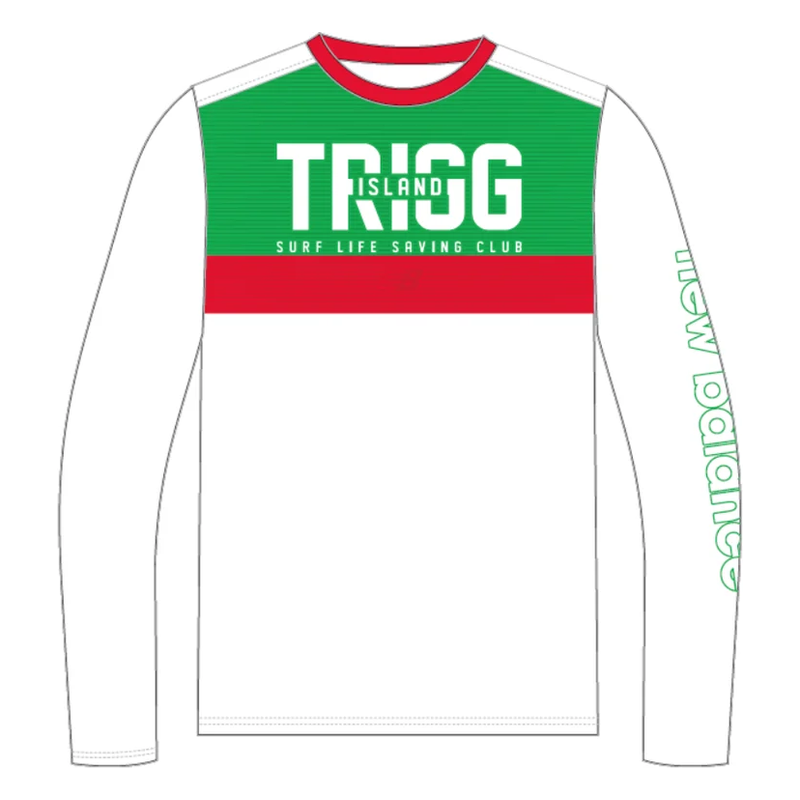
Corduroy cap
Hooded jacket
Tip
The range changes from season to season. The online shop always has the current list, along with sizing and prices.